Stableford: one bad hole can't end your round.
Points instead of strokes, and the highest total wins. It's the format that lets you make a 9 on the 4th and still be in it on the 18th.
Points instead of strokes, and the highest total wins. It's the format that lets you make a 9 on the 4th and still be in it on the 18th.
Stableford stops counting strokes and starts counting points. Every hole is scored against par — a birdie earns more than a par, a par earns more than a bogey — and your round is simply the sum.
Which means the whole thing runs backwards from what you're used to: the highest score wins.
The reason it exists is the hole everybody has had. You're two over through six, you find the water twice on the 7th, and you card a 9. In stroke play that number rides along in your pocket for the next eleven holes and the round is effectively finished. In Stableford that hole is worth zero points, and that's the end of it. You walk to the 8th tee still in the tournament.
It's the most forgiving format in golf, which is exactly why clubs run their weekend competitions under it. A high handicapper can have three disasters and still post a number worth turning in.
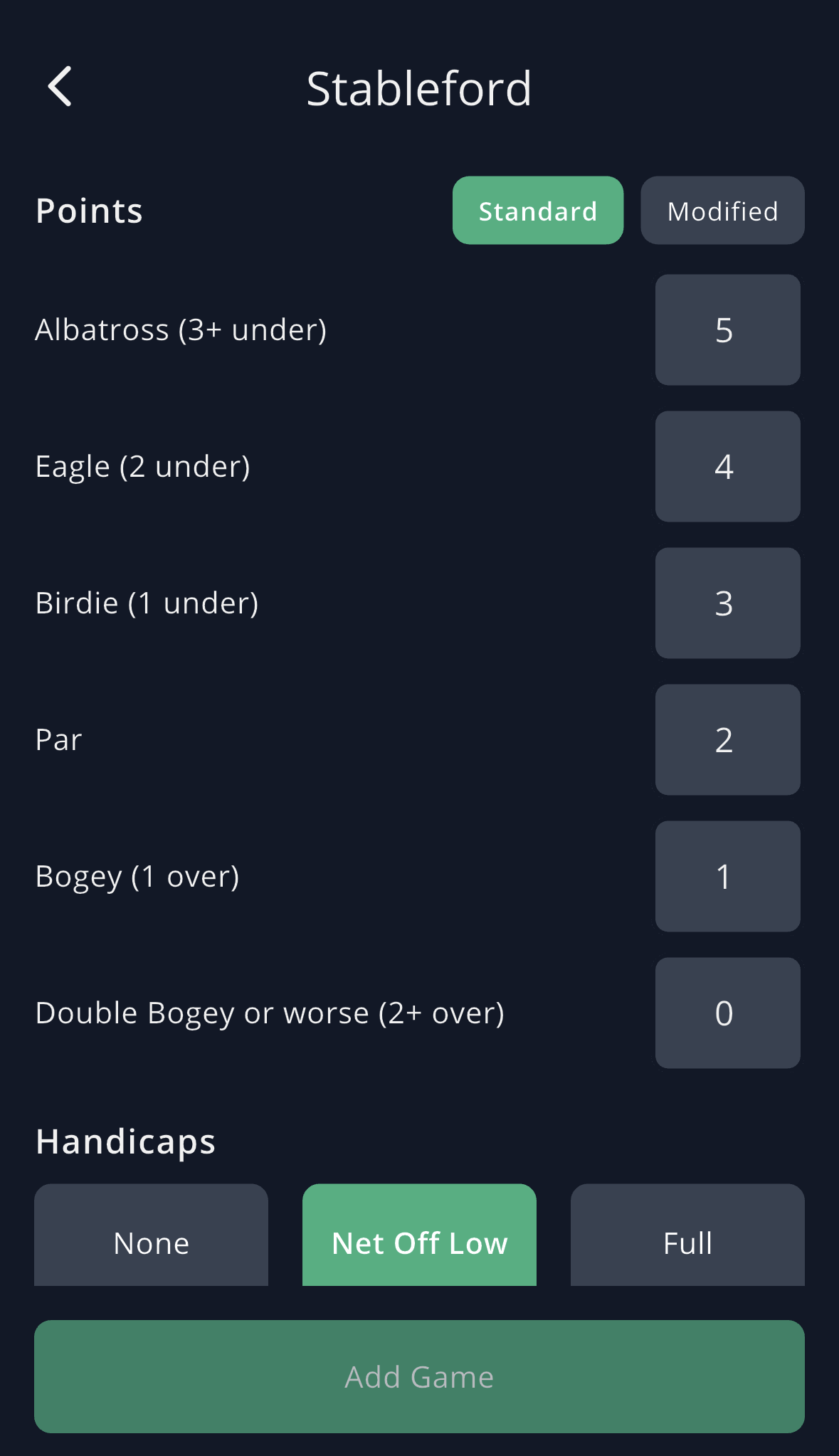
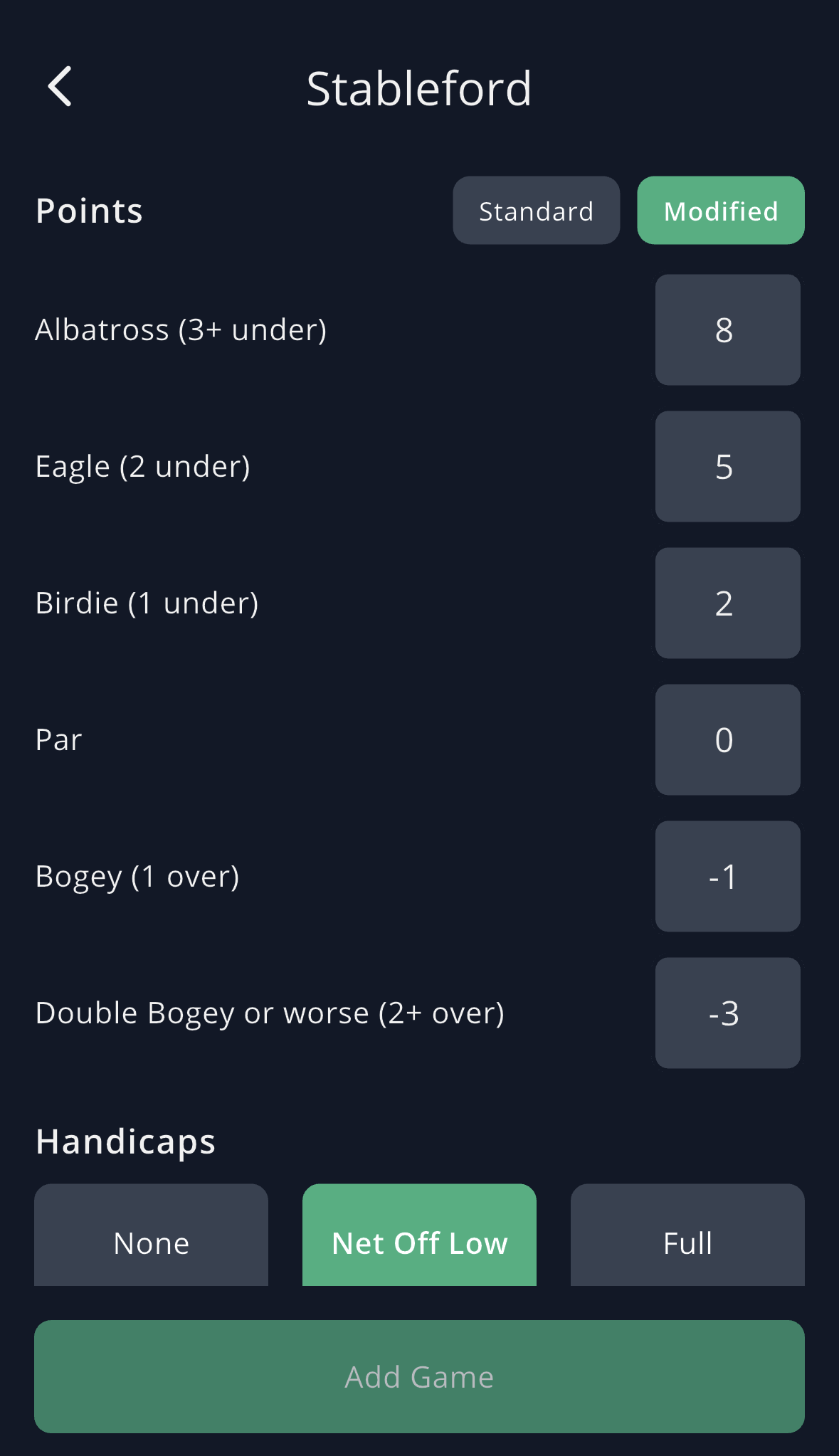
Two scales ship with the game. Standard is the classic, and it never goes below zero. Modified pays big for birdies and takes points off you for bad holes.
Under Standard, a par is 2 points. Eighteen pars is 36 — which is why 36 is the number everyone quotes. Play to your handicap and that's roughly where you land, so a net 38 means you beat your handicap by two.
Under Modified, par is worth nothing at all. You only move by making birdies or making mistakes, and a double bogey costs you 3. That's the scale the PGA Tour uses at the Barracuda Championship, and it's built to make players fire at flags — laying up for a safe par gains you exactly zero.
Neither scale is locked. Every value in the list is an editable field, so if your group has always paid 4 for a birdie, type 4 and play it your way.
One screen, and most of it you can leave alone.
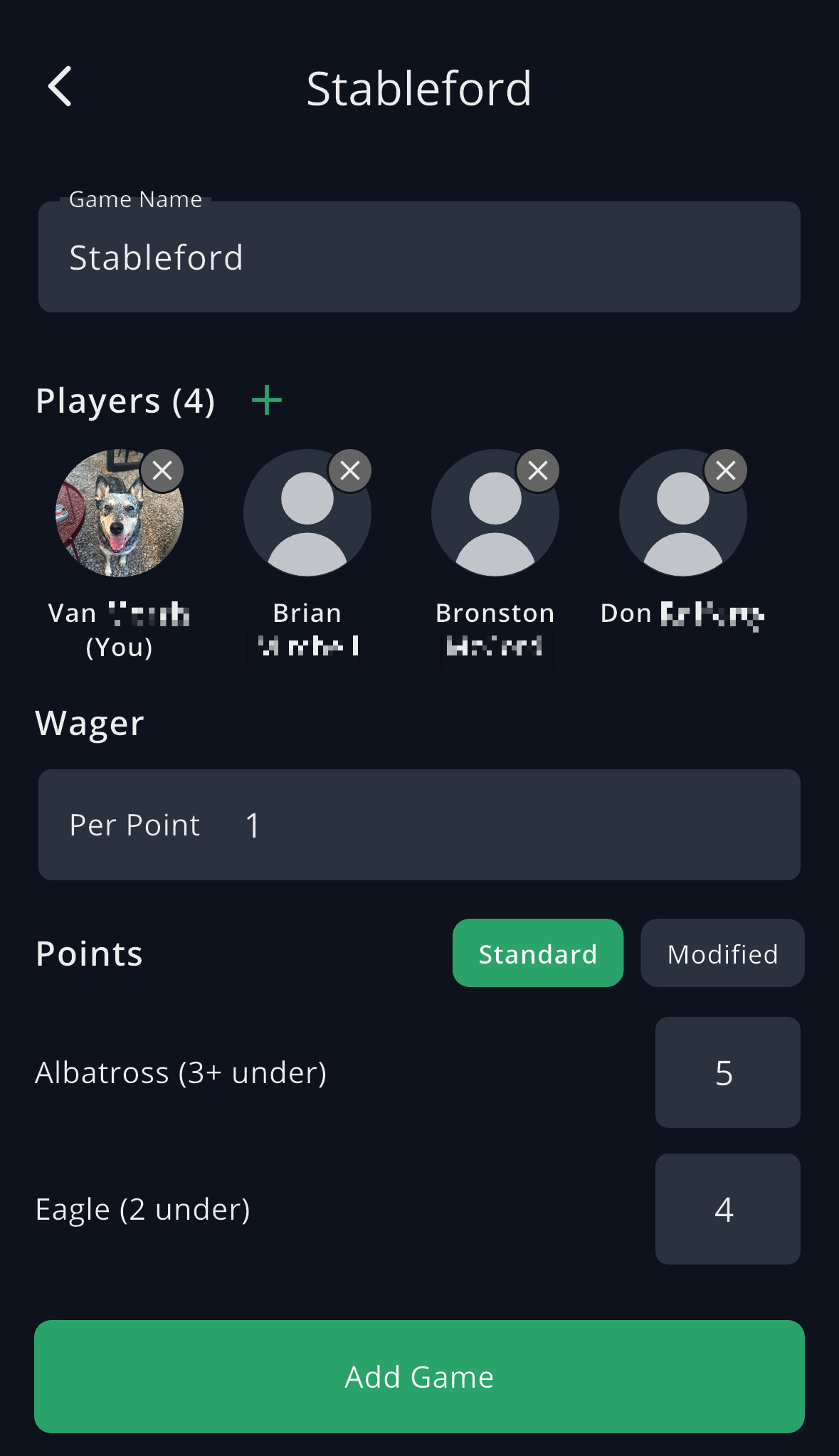
The wager is per point rather than per round, so the money follows the golf. Win by six points at a dollar a point and you're up six.
Tap Add Game and it starts scoring itself.
Nobody has to do points math on the tee box. Everyone enters the same raw scores they'd enter for any round, and GolfApp converts each one against that hole's par — applying handicap strokes where they fall — into the points total.
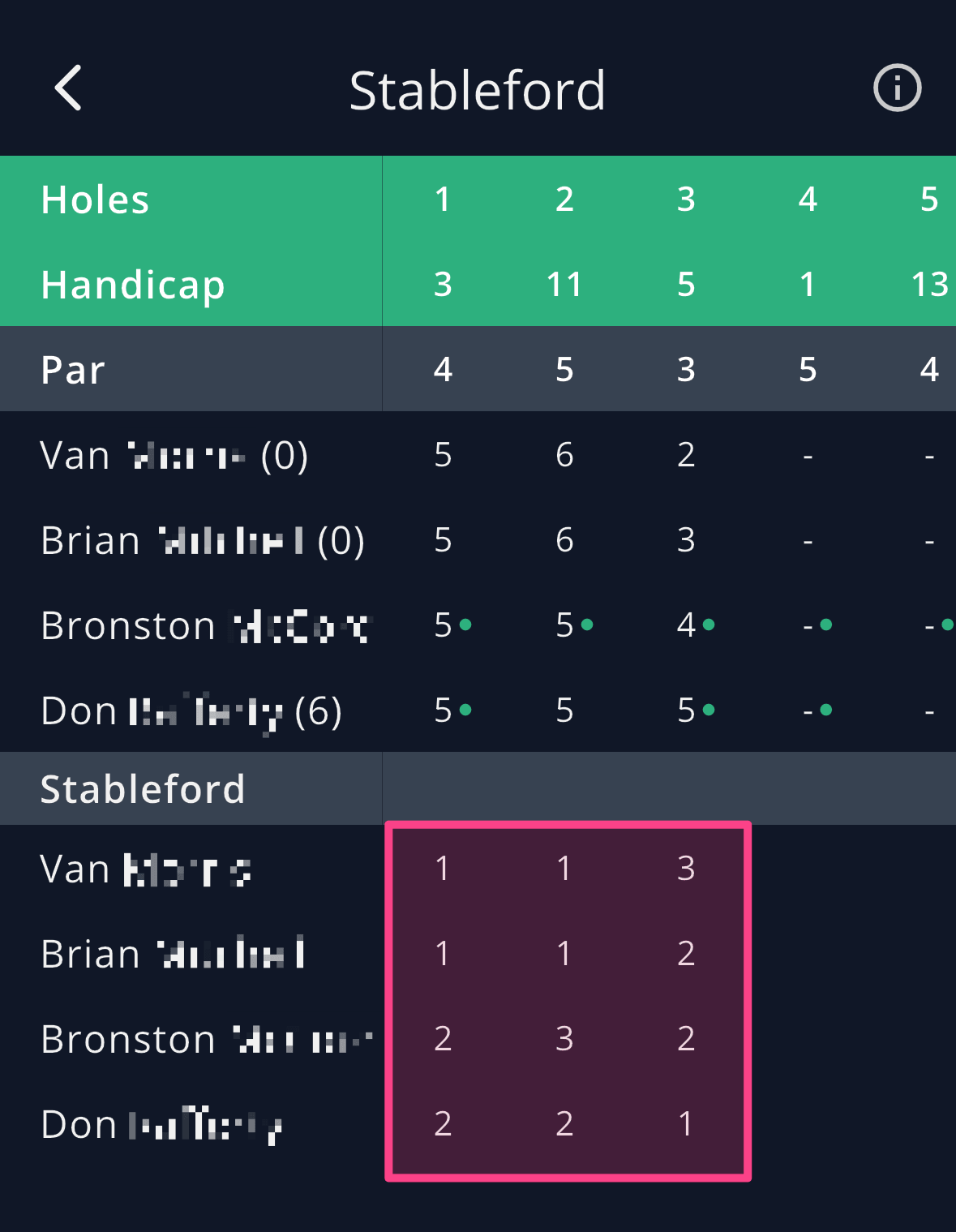
The card keeps both halves visible on purpose. The top is what everybody actually shot, and the section underneath is what it was worth — so when somebody asks how a 5 turned into 2 points, the answer is sitting right there with the handicap dot beside it.
And because it scores off the same numbers as everything else, a Stableford can run on top of other games — a Nassau inside your foursome, a skins game across the field, and a Stableford over all of it, from one set of scores. That's the whole idea behind the golf betting app.
Mixed abilities. With handicaps on, a 20 and a 5 can play the same game and both have something to shoot at on every hole.
Big groups. No partners to arrange, no draw to make. Everyone plays their own ball, and latecomers can still be in it.
Slow rounds. Once a hole can't earn a point there's nothing to gain by finishing it out, which quietly saves the group a lot of time over 18.
Anyone having a rough day. This is the real reason. Stroke play punishes a bad hole twice — once when it happens and again every time you look at the card. Stableford charges you once and moves on.
Stableford turns each hole into points instead of strokes. You score against par on that hole — a birdie is worth more than a par, a par more than a bogey — and your round is the total of those points. Unlike stroke play, the highest score wins.
Under standard Stableford scoring a double bogey or worse is 0 points, a bogey is 1, a par is 2, a birdie is 3, an eagle is 4, and an albatross is 5. You add up the points from all 18 holes and the biggest total takes it.
High. It's the opposite of stroke play. You're collecting points rather than counting strokes, so the player with the most points at the end wins.
36 points is the benchmark. Under standard scoring a par is worth 2 points, so 18 pars is 36 — which means a net 36 is playing exactly to your handicap. Anything above that is a better round than your handicap says you should have played.
Modified Stableford is a more aggressive point scale that rewards birdies and eagles heavily and actively punishes bad holes. A common set is albatross 8, eagle 5, birdie 2, par 0, bogey -1, and double bogey or worse -3. It's the format the PGA Tour's Barracuda Championship is played under, and it pushes players to attack pins instead of protecting par.
Standard scoring never goes below zero, so a blow-up hole just costs you the points you would have earned. Modified scoring takes points away — a double bogey is -3 — so a disaster hole genuinely hurts. Standard is the friendlier game, Modified is the one that creates swings.
Because one terrible hole doesn't end your round. In stroke play a 10 on a par 4 follows you all the way to the clubhouse. In Stableford that hole is worth zero points and then it's over — you tee off on the next hole with everything still in front of you. It also speeds play up, since there's nothing to gain from putting out once a hole is worthless.
It can, and it usually does — that's what makes it work in a mixed group. GolfApp gives you three options when you set the game up: None for straight gross points, Net Off Low where the lowest handicap plays at scratch and everyone else gets the difference, or Full where every player gets their full course handicap.
As many as you want. Nobody needs a partner and nobody needs an opponent — everyone is playing their own ball for their own point total, so it scales from a twosome up to a full field.
GolfApp scores Stableford — standard or modified, with every point value editable and handicaps applied automatically — free for life, with no subscription or premium tier.
 Skins
SkinsOne prize per hole, and you have to win it outright. The game that works with four golfers or forty.
 Nassau
Three bets in one round: front nine, back nine, and the overall. Automatic presses included.
Run Stableford alongside a Nassau and a skins game off the same scores.
The toggles behind every game, and what each one changes.
Free for life. No subscription, no premium tier.
Download for Free