
Stroke play: every shot counts.
Count every shot, lowest total wins. Then pick how you want to run it: on your own, with a partner, or as a foursome against the whole field.
Count every shot, lowest total wins. Then pick how you want to run it: on your own, with a partner, or as a foursome against the whole field.
You count every shot. All of them, all the way round, into one number. Lowest total wins.
That's it, and it's why stroke play is the format almost every professional tournament uses and the one most golfers mean when they say they shot 84. You'll also hear it called medal play — same thing, older name, still used for a club's monthly medal.
The difference is what a bad hole costs you. In match play a hole is worth one hole, so losing it by one shot and losing it by six are identical. In stroke play every one of those six shots goes in your pocket and stays there.
Which makes stroke play the more honest measure of a round and the more brutal one. There's no hiding a triple bogey — it's still on the card on the 18th green.
That brutality is exactly why the team formats below exist. Let a partner's score cover your worst hole and stroke play stops being punishing without stopping being stroke play.
One setting at the top of the setup screen decides everything else: whose ball counts. The scoring underneath never changes.
Every golfer plays their own ball and their own total. Lowest net score in the field wins. This is stroke play in its plainest form and it scales to as many players as you can get on the tee sheet.
Two golfers to a team, and the lower of their two net scores counts on every hole. The format most trips and outings are built on.
Full Net Best Ball rulesFour golfers to a team, with the two lowest net scores counting on each hole. More forgiving again, and the one to use when the spread of abilities is wide.
Full 2 Best Ball rules
Choose the competition, drop players into teams if you're running one of the team formats, and everything downstream — the scorecard, the leaderboard, the payouts — follows from that one choice.
On Player vs Field there are no teams to build. Everyone goes into one list and plays their own ball.
Individual is the default. You only need teams if you want them.
Everyone plays their own ball, counts every shot, and the lowest net total wins. No partner to cover a bad hole and no team score to hide inside.
This is what serious golf is played under. Club championships are stroke play. So are qualifiers, and so is essentially every week on tour. When a result has to actually mean something, this is the format that gets used — because it measures the whole round rather than a series of small separate contests.
It works perfectly well for a Saturday too. Set a buy-in, add your group, pay the winner, and you can play a mate straight up for cash with nothing else going on.
We'd gently point you at the other formats. Straight stroke play between two friends is honestly the least interesting thing GolfApp does, and the rest of the list exists precisely because counting one number for eighteen holes is a serious way to play golf rather than usually a fun one.
So save stroke play for when it counts. Or run it as Pair vs Field, so at least somebody is covering your triple on the 6th.
Stroke play is the format that wants a purse, because everyone finishes with a number and those numbers rank cleanly from first to last.
Everyone pays the same buy-in, which builds the purse. Then allocations decide how it comes back out. Pay the winner only, pay the top three, pay five deep if it's a big field — you add as many places as you want and set what each one takes.
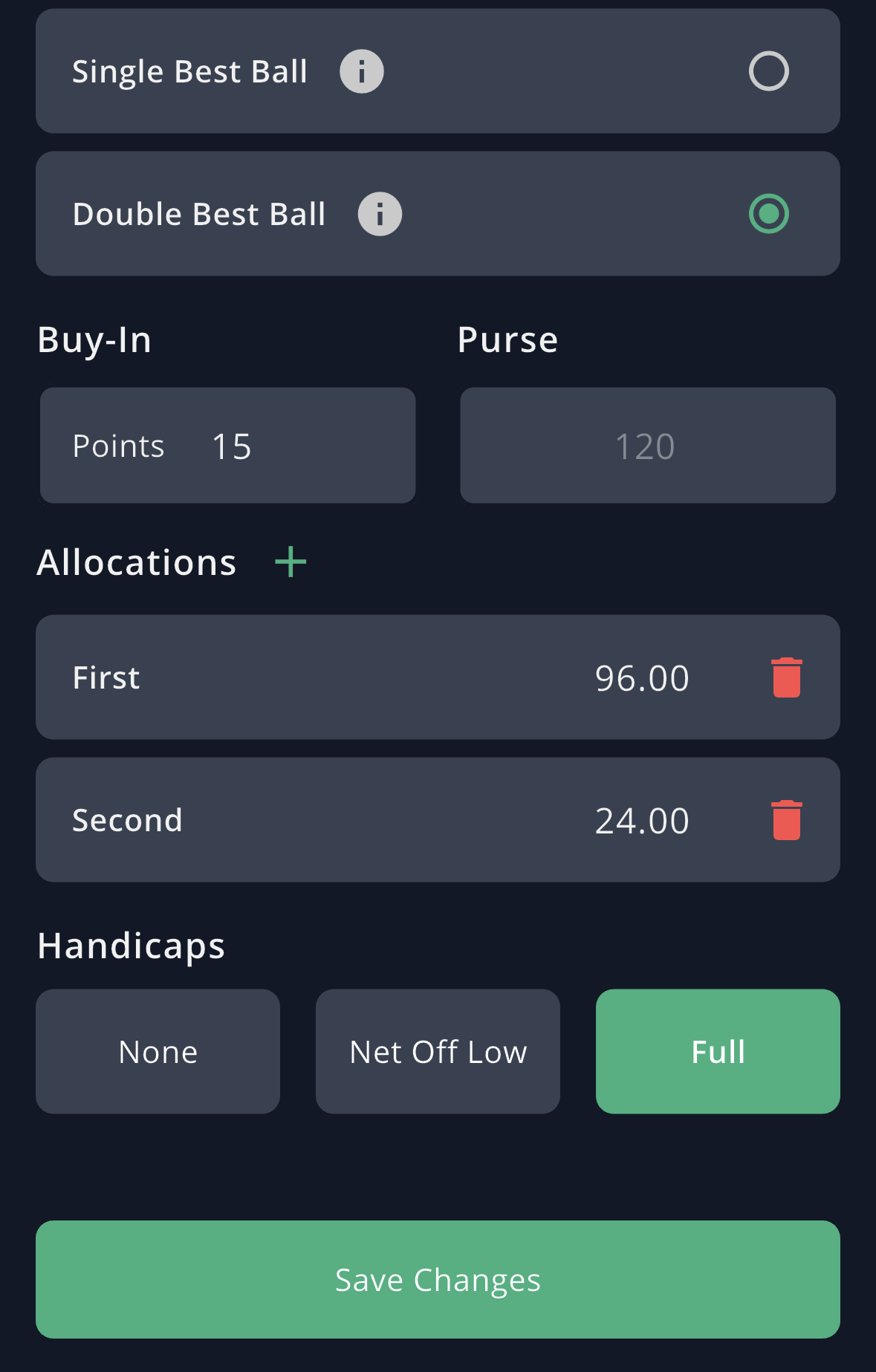
Anybody outside the paid places shows $0 on the leaderboard rather than disappearing off it, so everyone can see where they came and what it was worth.
It updates as scores go in, so it's worth knowing during the round rather than after it.
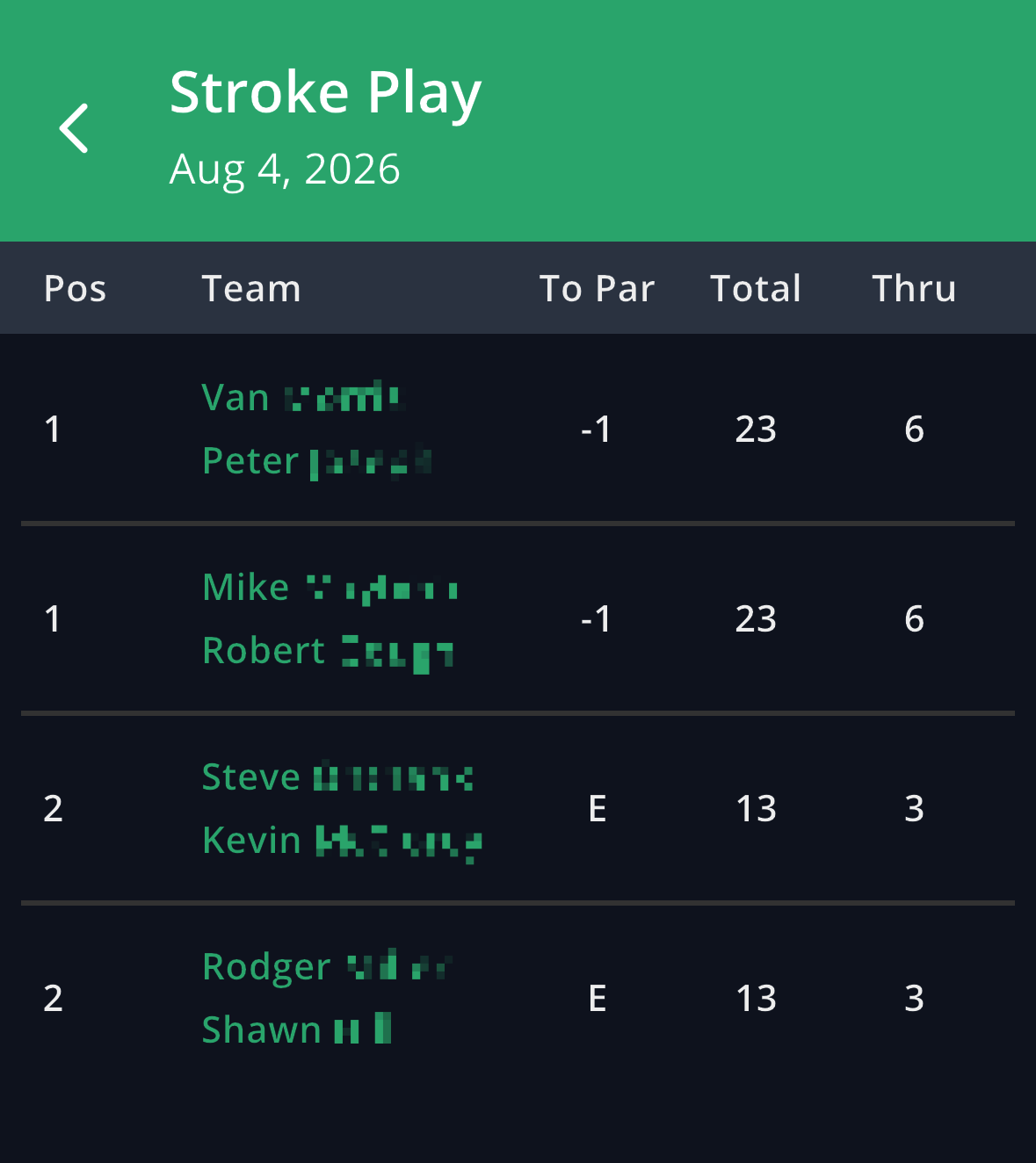
Thru is the one people skip and shouldn't. Level par through 3 and level par through 15 are not the same round, and the column is what stops a group on the 4th tee thinking they're winning.
Stroke play is the family where Full handicaps make the most sense, and it's what GolfApp defaults to.
The logic comes from what you're playing against. In a match there's one opponent, so measuring everyone off the lowest handicap in the group — Net Off Low — gets to the same result with fewer strokes to track. Here you're playing a whole field, and every player's score has to be comparable with every other player's. That only works if everyone gets their own strokes, applied the same way.
Set it at setup and the dots appear on the scorecard wherever the strokes fall.
If you're putting on anything bigger than a foursome, stroke play is what holds it together — because it's the only family that ranks everybody against everybody without pairing anyone off.
Groups go out in whatever order suits the tee sheet. Nobody needs a draw, nobody needs an opponent, and nobody is knocked out. Everyone just plays and the leaderboard sorts it.
And because it scores off the same raw numbers as every other game, it's the layer everything else sits on top of. Run a team stroke play game across the whole field, individual Nassaus inside each group, and a skins game over all of it — one score per hole, three games settling themselves. Mixing games covers how.
For most trips the sweet spot is Pair vs Field, which is why it gets its own page and its own recommendation.
Stroke play counts every shot you take across the whole round and adds them into one total. The lowest total wins. It's the format almost every professional tournament is played under, and it's the one most golfers mean when they talk about shooting a score.
Yes. Medal play is an older name for the same thing — every stroke counted, lowest total wins. Club competitions still use the term, particularly for a monthly medal, but there's no difference in how it's played.
Stroke play counts every shot into one total for the round. Match play scores hole by hole, where winning a hole by one shot is worth the same as winning it by five. In stroke play a blow-up hole follows you to the clubhouse; in match play it costs you that hole and nothing more.
Each player gets handicap strokes on the holes their course handicap says they should, and their net total is what competes. GolfApp applies the strokes automatically and marks them on the scorecard, so a 20 handicap and a 4 can play the same competition and both have a chance at it.
Yes, and it's how most outings run it. GolfApp gives you three Competition settings: Player vs Field for individuals, Pair vs Field for two-man teams where the lower ball counts, and Foursome vs Field for four-man teams where the two lowest balls count. The scoring underneath is identical — only the question of whose ball counts changes.
Everyone pays the same buy-in, which builds the purse. You then set allocations deciding how much each finishing position takes — pay just the winner, or pay five places deep. GolfApp works out the payouts and shows them on the leaderboard, with anyone outside the money showing $0 rather than being hidden.
When the result has to mean something. Club championships, qualifiers and professional events are all stroke play, because it measures the whole round rather than a series of separate contests. For a casual round with friends, a Nassau, a skins game or a team best ball usually makes for a better day — counting one number across eighteen holes is a serious way to play golf more than a fun one.
As many as you can get out. Nobody is playing anybody directly — every player or team is measured against the field — so groups can go off at different times, in any order, and still all be in the same competition.
Thru is how many holes that player or team has completed. A group showing Thru 6 has played six holes, and F means they've finished. It's what lets you read a live leaderboard properly — a team at level par through 3 hasn't done the same thing as a team at level par through 15.
Usually yes, and Full is the default. When you're playing a whole field rather than one opponent, every player needs their own strokes measured the same way so the scores are comparable. Net Off Low, where the lowest handicap plays at scratch, is better suited to a match between two sides.
GolfApp scores stroke play free for life — individual or team, handicap strokes applied automatically, a live leaderboard for the whole field, and the purse split according to your allocations. No subscription and no premium tier.
Net Best BallPair vs Field, in full. Two-man teams with the lower ball counting on every hole.
2 Best BallFoursome vs Field, in full. Four-man teams with the two lowest balls counting.
 Match Play
The other way to settle a round — hole by hole, where a 9 costs you exactly one hole.
 Stableford
Stroke play's friendlier cousin. Points per hole, so a disaster can't wreck the round.
Free for life. No subscription, no premium tier.
Download for Free