Every game you add to a round gets its own scorecard. The layout can vary slightly depending on the format — some games use match play scoring, some use stroke play, some use points — but the basics are the same across all of them.
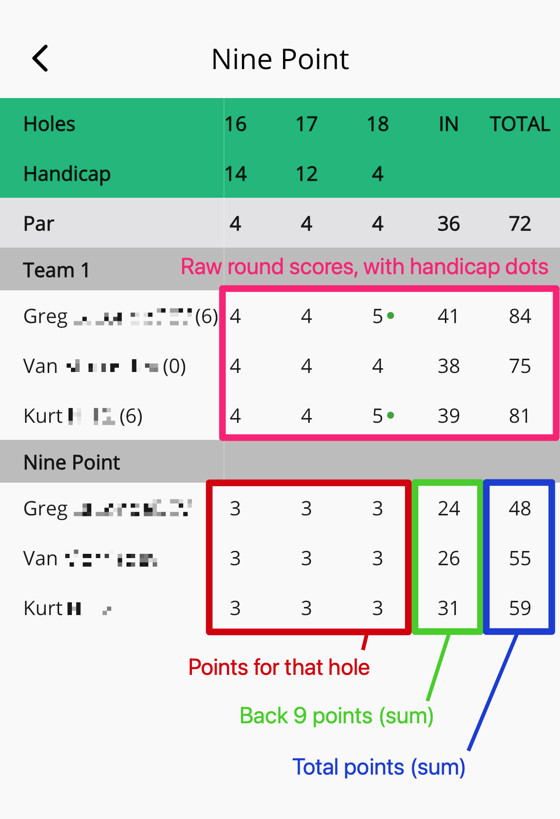
Here's Nine Point (also known as 5-3-1) as an example. It's not a perfect example since the golfers tied on the last three holes, but it shows the structure well.
Game name
The game name is displayed at the top of the scorecard — in this case, "Nine Point."
Raw scores above the fold
The top section shows each participant's gross round scores along with their course handicaps and handicap dots — the same information you'd see on the round scorecard. This gives you context for how the game results were calculated.
Calculated results below the gray bar
Beneath the gray divider is where the game's scoring logic kicks in. This section shows the algorithmic or calculated result for each golfer on each hole.
In the Nine Point example, each hole's 9 points are split among the three golfers based on performance — the winner gets 5, second place gets 3, and last place gets 1. When golfers tie, the points are divided evenly.
Every game format will show something different here — match play holes won, stroke play totals, Stableford points, etc. — but it always represents the game's calculated output, not raw scores.
Subtotals and totals
To the right of the per-hole results, you'll see subtotals for the front 9 or back 9 (depending on which holes are in view), followed by the total for the entire game across all holes played.
In the Nine Point example: Greg earned 24 points on the back 9 and 48 total across all 18 holes.