Pari-mutuel wagering for your member-guest. Major pools for Masters weekend. Set up from the web admin panel, joined from anywhere, and settled without a shoebox of slips and a legal pad.
Ask anyone who has run the betting side of a member-guest what the week actually looks like and you'll hear some version of the same thing: a folding table, a line of members, a stack of handwritten slips, and someone in the back office trying to reconcile all of it against a cash box after the last group comes in.
It works. It has worked for decades. But it eats a staff member for two days, it produces a paper trail that only exists on paper, and every question that comes up afterward — who did I have? what did I win? did my bet ever get logged? — lands back on the pro shop.
It scales down, too. Swap the folding table for a group text and the cash box for one guy's Venmo, and a twelve-person Masters pool has all the same problems in miniature. Somebody is still the bookkeeper, and it's still the worst job at the event.
That's the part GolfApp takes off your desk — whether the desk is in a pro shop or your kitchen.
Both are set up the same way and settled the same way. What changes is the field being bet on.
Member-guest · Member-member · Leagues · Trips
Participants bet on the teams in your own field. Everything goes into a shared pool, and the pool pays out when your event finishes.
How pari-mutuel worksThe Masters · U.S. Open · The Open · PGA
Participants pick the pros they think will finish best — one golfer straight up, or one from each tier with a tiebreaker. Live scores run all weekend, and the pool pays out when the tournament does.
How major pools workA club runs the most of these, but neither one needs a clubhouse. A public-course league, a charity scramble, a buddies trip, or twelve friends who want a pool going for Masters weekend all use the same setup.
You build the event once, in the GolfApp web admin panel. From there it's a join code — and how somebody uses that code is entirely up to them. All three paths write to the same pool and the same ledger, so you're never merging two systems at the end of the day.
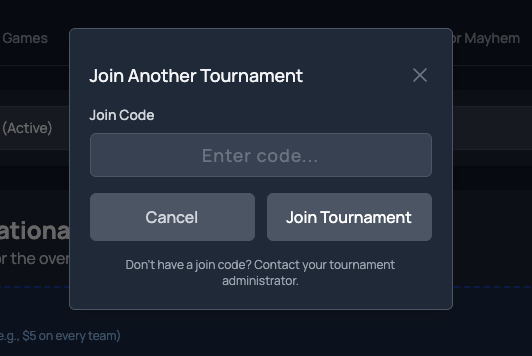
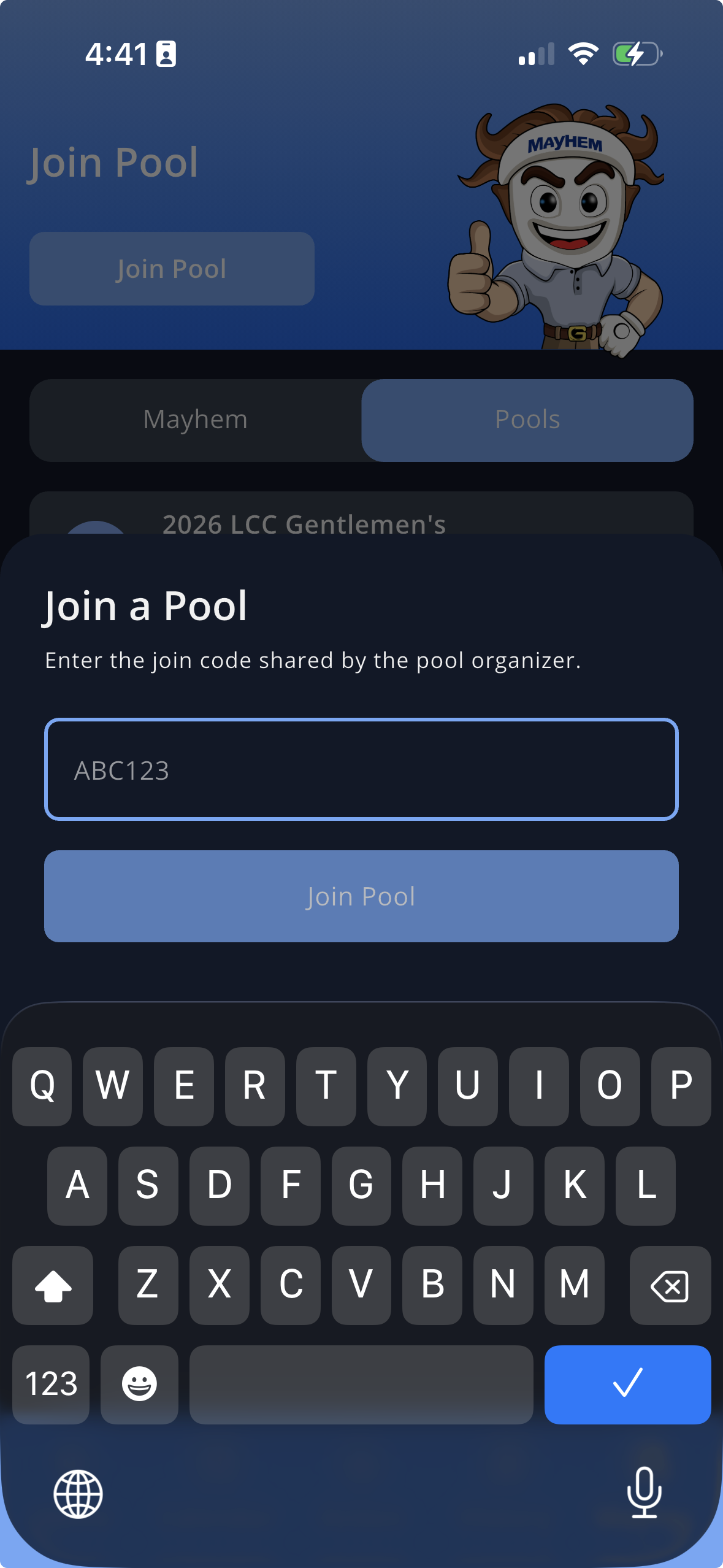
Members open the Pools tab, punch in the join code you sent out, and they're in. From there they can browse the field and place bets from the couch — which, as it turns out, is the whole point.
No app required. The same join code works in a browser, which matters more than you'd think for the guest who is playing your event once a year and isn't going to install anything to do it.
Some members are always going to walk up and hand you a twenty. Fine. A pro or assistant logs the bet on their behalf, picking them out of the field or typing a name, and it lands in the same ledger as everything else.
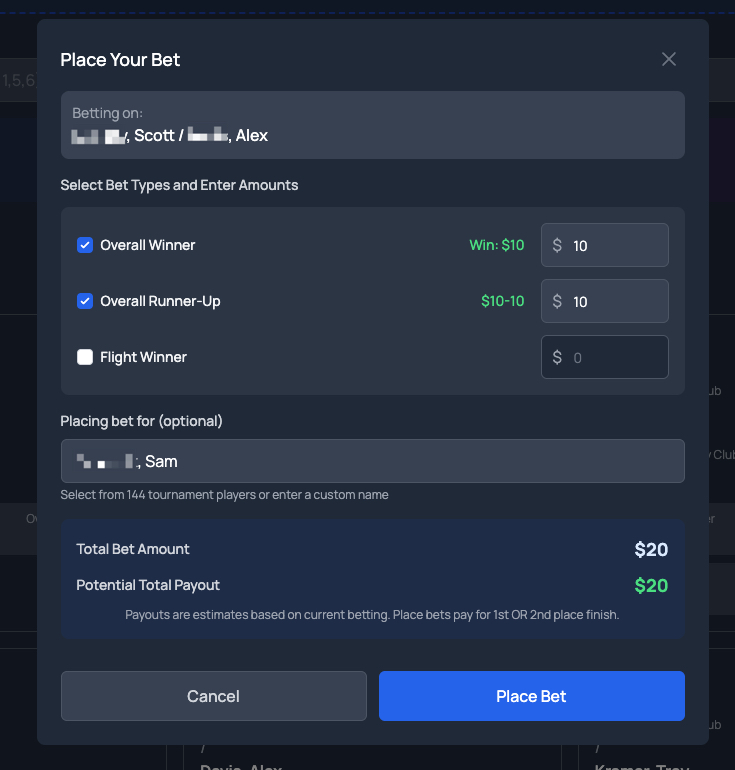
Note the two things happening on that screen: a member is backing more than one bet type at once, and the total is adding up live as they go. Multi-bet is supported everywhere — nobody has to queue up three times.
Taking bets is the easy half. What decides whether you run your event this way twice is Sunday evening — when the pool has to pay out, and somebody asks about a five dollar wager they placed on Tuesday. Either you can answer that in a few seconds, or you're going through a stack of paper looking for it.
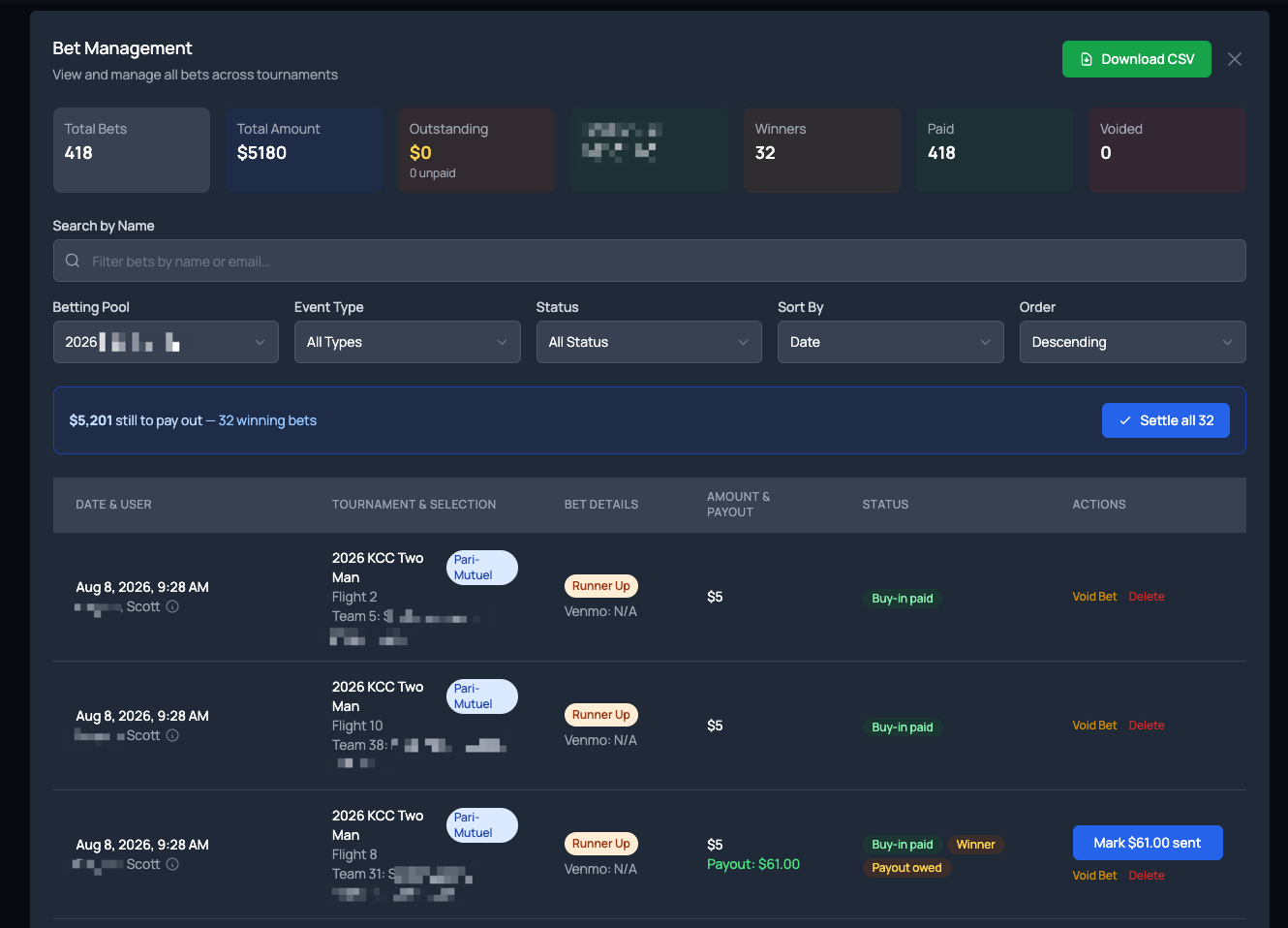
Search by name or email, filter by pool, event type or status, sort by whatever answers the question in front of you. The counters stay current — total bets, total in the pool, what's still outstanding, how many winners, how many are paid.
And notice that money in and money out are two different columns. Buy-in paid means you collected. Payout owed and payout sent mean it's gone back out to a winner. You can settle one at a time or clear all the winners at once.
Betting is open.
Betting is closed because play has started.
Winners are determined and payouts are ready.
Most of the friction in a paper pool comes from rules that live in one person's head. Here they're settings on the event — which bet types are on the board (overall winner, overall runner-up, divisional winner, flight winner, each on or off), a house percentage held back for the club, wagers required in $5 or $10 increments, a minimum and maximum on any single bet, a cash-only mode that takes Venmo off the table entirely, and payouts rounded down so nobody is making change when three people split a $100 pot.
When it's over, you can pull a full spreadsheet of every bet — who placed it, what they took, for how much, its status, and the timestamp — plus PDF readouts in two versions: one for internal use, one you can hand out or post. More on the administrator's side here.
This is the outcome we hear about most, and it isn't really about software.
When the only way to bet is a table in the clubhouse on the morning of the event, you are asking members to make a decision in a line, in a hurry, with somebody waiting behind them. Plenty of them just don't. Not because they didn't want in — because the window was twenty minutes wide and they were trying to get to the range.
Open the pool days early and the whole thing changes. Members join when the code goes out, sit with the field, talk about it, change their minds, and place a bet from their kitchen table on Tuesday night. By the time your desk opens on Friday, a large share of the pool is already in.
Bigger pool, bigger payouts, more people with something riding on the event — and a much shorter line on the morning of.
Separate from the pool, but very much the same spirit: anyone in GolfApp can send another player a Mayhem bet — a free-text, anything-goes prop wager. Closest to the pin on 7. First one in the water buys dinner. It's the side action that happens at every event anyway. It just doesn't have to live on a napkin.
Bets get settled the same two ways they always have. A participant can pay through Venmo, or hand cash across the desk and have the club mark the bet as paid. Both are first-class — we're not trying to move your club onto a payment rail it didn't ask for.
What's different is the record. Every bet — placed on a phone Tuesday, in a browser Thursday, or at your table Friday morning — sits in one ledger with a name on it. Who's in, who's paid, who's owed, and what the pool is worth right now.
When the event finishes, that's the paperwork. There isn't a second version of it in a drawer.
Anyone running pari-mutuel events and major pools has a few options, and we'd rather you hear them from us. Homestretch Golf is a name that comes up — we hear about groups using it for exactly this. Golf Genius handles tournament operations for a great many clubs and covers this ground too.
Where GolfApp is different is what happens on either side of the event. Your people already have GolfApp for their Saturday game — Nassau, Skins, Wolf, Scotch, the trip in the fall, the running tally against the same three guys they've been playing for fifteen years. The pool isn't a separate product they sign up for. It's one more thing in the app they're already using, which is a meaningful part of why participation moves.
And GolfApp is free for the individual golfer. Always has been, and that isn't a promotion. Nobody hits a paywall on the way into your pool.
It's a wagering style, not a game. Everyone's money goes into a shared pool, the club takes the bets across every entry in the field, and the pool is divided among the winning wagers at the end. Clubs use it for member-guests, member-members, and invitationals, where there's a full field to bet on rather than a single foursome.
Same idea, different field. A major betting pool — Major Mayhem in GolfApp — runs off a professional tournament. Participants pick which pros they think will finish best, either straight up on one golfer or one from each tier with a tiebreaker, and the pool pays out when the real event does. Clubs and friend groups run these for the Masters, the U.S. Open, the Open Championship, and the PGA Championship.
Yes. GolfApp pulls live scores from the tournament, so a participant's picks sit against the real leaderboard every time they open the app or the web panel. Nobody is cross-referencing an entry against a leaderboard by hand on Saturday morning.
No. They can join and place bets from the GolfApp mobile app, from GolfApp on the web, or in person at the desk with a pro or assistant logging the bet on their behalf. All three feed the same pool and the same ledger.
Either way you already handle it. Bets can be settled through Venmo, or a participant pays cash at the desk and the club marks the bet as paid. Everything shows up in one place either way, so nobody is reconciling a stack of paper slips against a cash box.
Yes. Multi-bet is supported throughout — a participant can back several entries, across several bet types, and settle up in one go rather than transaction by transaction.
Whoever is running it. Both event types are configured from the GolfApp web admin panel — usually by a club pro or tournament administrator, but a league organizer or the person running a buddies trip uses exactly the same tools. Participants only ever see a join code.
No. Private clubs run the most of these, but nothing about either format requires a clubhouse. Public-course leagues, charity events, buddies trips, and a group of friends who want a pool for Masters weekend all use the same setup.
GolfApp runs the ledger — who bet what, on whom, for how much, and what's owed at the end, with money collected and money paid out tracked as two separate things. Settlement happens through Venmo or in cash at your desk, the same as it does today. What changes is that you stop keeping the record by hand.
The rules of the pool are settings on the event rather than things somebody has to remember and enforce. Choose which bet types are live — overall winner, overall runner-up, divisional winner, flight winner — then hold back a house percentage, require wagers in $5 or $10 increments, set a minimum and maximum on any single bet, declare the event cash-only so Venmo is off the table, and round payouts down so nobody is making change when three people split a pot.
A full spreadsheet of every bet in the event — who placed it, what they took, the amount, the status, and the timestamp. There are also PDF readouts in two versions: one for internal use, one you can distribute or post.
Every event is in one of three states. Active means betting is open. Inactive means betting is closed because play has started. Completed means winners are determined and payouts are ready to go out.
GolfApp is free for individual golfers, always. For organizer-run events, get in touch and we'll walk you through it.
Member-guest, member-member, or a pool for the Masters — send us the details and we'll walk you through running it in GolfApp.
Talk to us about your eventAlready set up? Head to the web admin panel.