Run the Masters pool. Skip the group text.

Participants pick the pros, then watch it all weekend on live scores. GolfApp takes the entries, tracks who's paid, and settles it up — so nobody spends Sunday night with a spreadsheet and a leaderboard in the other tab.

Run it for Any major
Formats Straight or tiered
Scoring Live all weekend
Settled with Venmo or cash

What a major betting pool is

Four weekends a year, the golf world stops and watches the same thing. A major betting pool is how a club turns that into something its members are actually in.

The format is familiar to anyone who's ever filled out a bracket. Participants pick the professionals they think will finish best. Everyone's entry goes into a shared pot. The pot pays out when the tournament does. Clubs run them for the Masters, the PGA Championship, the U.S. Open and the Open Championship — and plenty of friend groups run the exact same thing without a club anywhere in sight.

It's the same pooled wagering idea as a pari-mutuel event at your member-guest. The only real difference is whose field you're betting on: the pros on TV rather than the members in your own tournament. GolfApp calls this event type Major Mayhem.

Two ways to run the pool

Some groups want it decided in thirty seconds. Some want to sweat all four rounds. You choose which one your pool runs.

Golfer Winner

Straight bet

Pick one golfer. That's the whole entry. If they win the tournament, you're collecting.

The simplest version, and the one that gets casual participants in — there's nothing to explain and nothing to get wrong.

Tiered Picks

Tiered bet

The field is split into tiers, and you take one golfer from each tier — a favorite, a mid-price name, and a long shot or two.

At the end, your lowest-scoring picks get dropped. You set how many: drop the two worst, drop one, or drop none and count them all. That's what keeps an entry alive after one of your golfers misses the cut on Friday.

Then a tiebreaker: predict the winning score relative to par. Closest call settles it when two entries finish level.

Why one person always ends up hating it

Every pool has an organizer, and the organizer's experience of Masters week looks nothing like everyone else's.

It starts as a group text. Then it's a spreadsheet. Then it's a spreadsheet plus a running list of who has and hasn't paid, which requires reminding grown adults about twenty dollars four separate times. Entries arrive by text, by email, and verbally in the parking lot, and one of them is going to get lost.

Then Sunday evening comes and the same person is reconciling picks against a final leaderboard, working out the split, and fielding messages from people who are certain they had somebody they didn't.

The pool is a great tradition. Being the person who runs the pool is a job nobody volunteers for twice.

Set it up once, share a code

The organizer builds the pool in the GolfApp web admin panel and sends out a join code. That's the whole setup. Everything after it is participants letting themselves in.

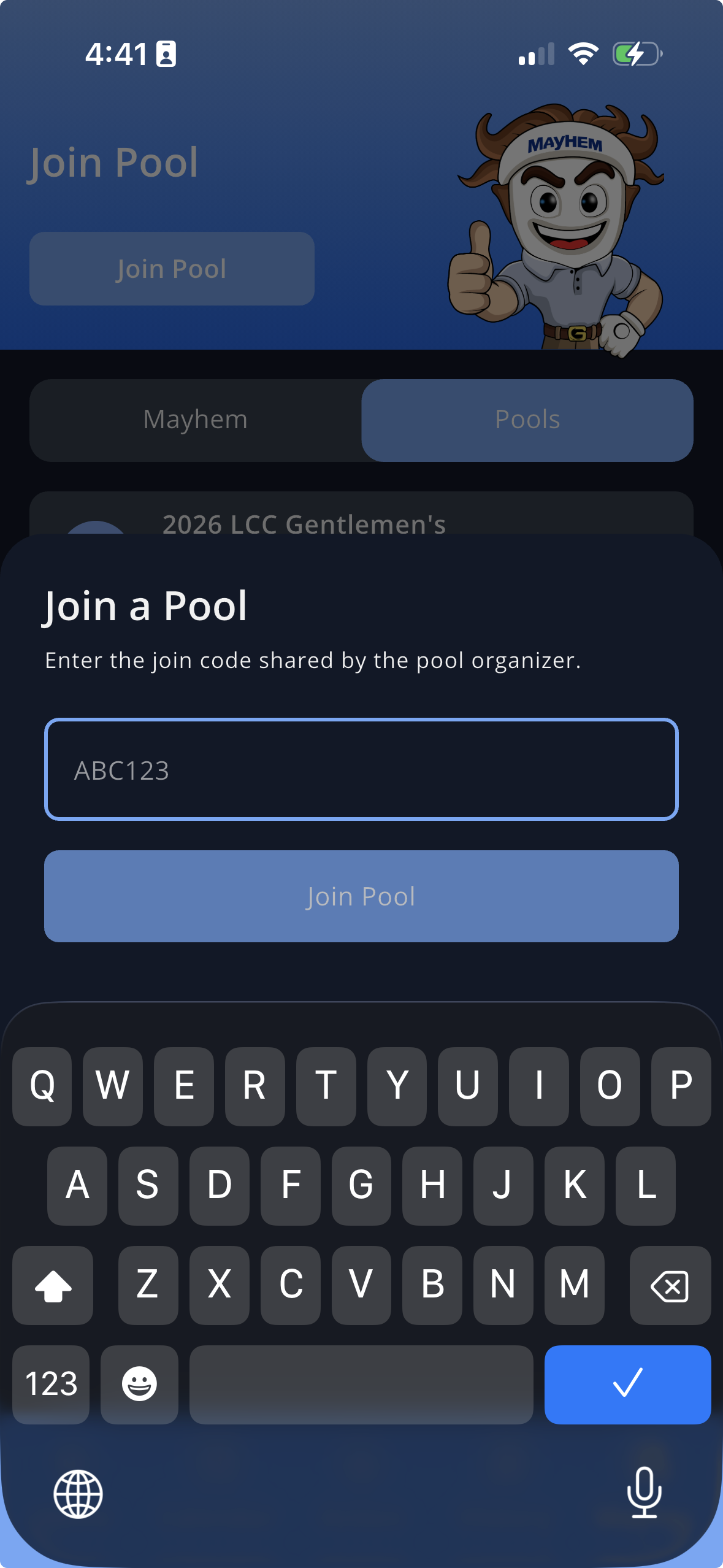
GolfApp mobile Pools tab with the Join a Pool sheet open, asking for the join code shared by the pool organizer
01

In the app

Open the Pools tab, enter the code, you're in. No sign-up thread, no "can you add me," no organizer manually collecting names.

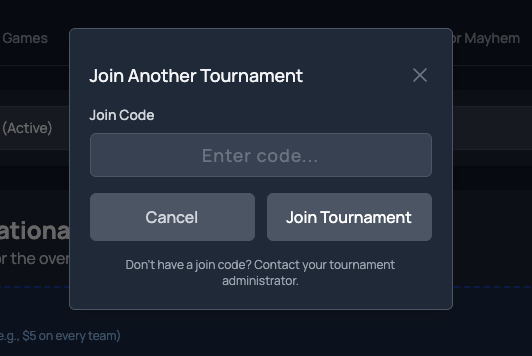
GolfApp web Join Another Tournament dialog with a join code field and a Join Tournament button
02

On the web

The same code works in a browser, which is what you want for the brother-in-law who's in the pool every April and has never installed a golf app in his life.

03

Or logged for them

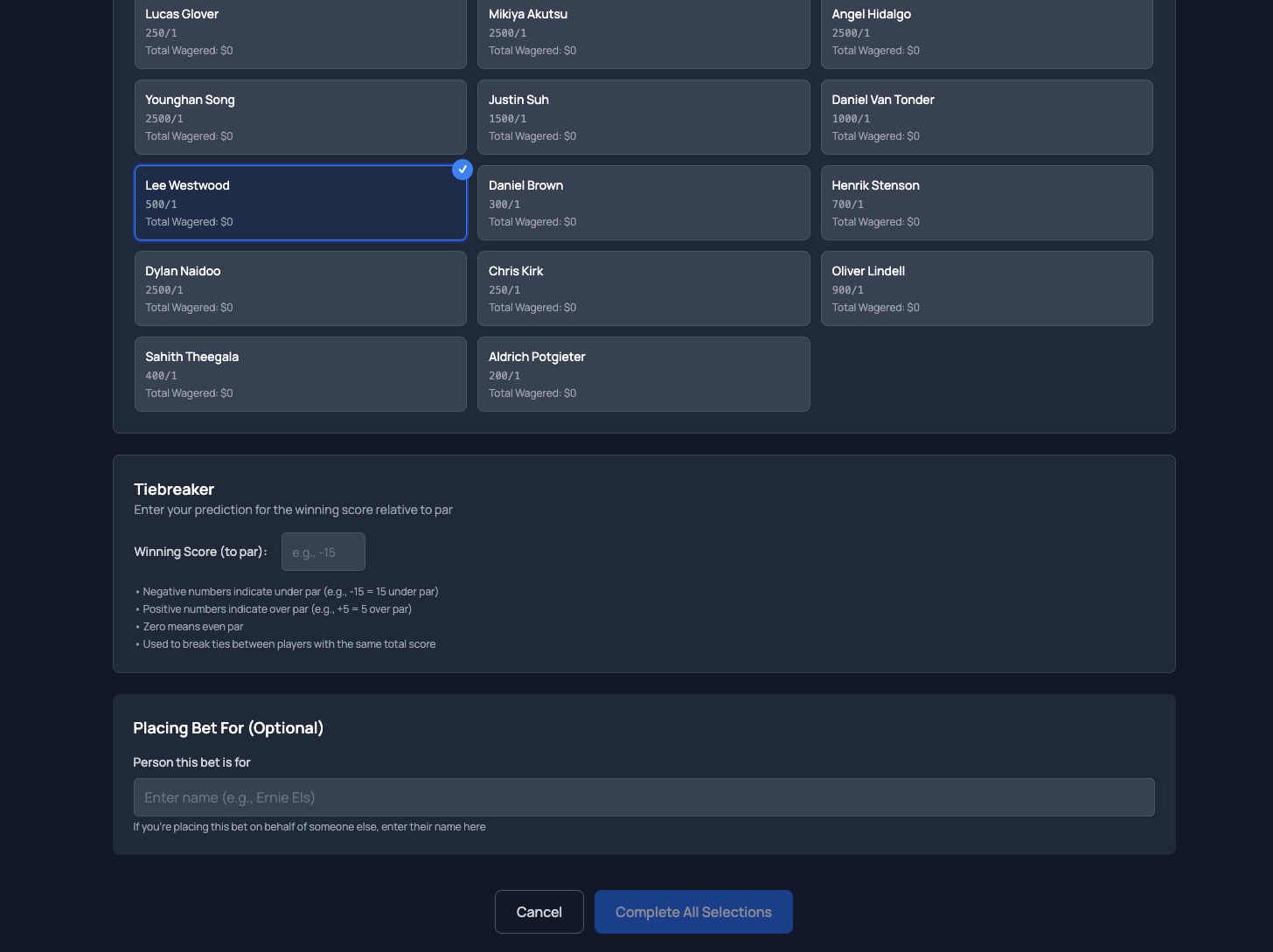
Not everyone is going to install an app or make an account to get into your pool, and some of them will just email you their picks. Fine. An organizer makes the selections in the web panel and drops the person's name into Placing Bet For, and the entry goes into the same pool as everyone else's — no side list, no asterisk, no spreadsheet running in parallel.

GolfApp web panel showing a grid of professional golfers with their odds and total wagered, one selected, a tiebreaker field for predicting the winning score relative to par, and an optional Placing Bet For field to enter the name of the person the bet is being placed on behalf of
Making a pick in the web panel. Odds and total wagered sit beside every name, the tiebreaker is in the same flow, and Placing Bet For lets an organizer enter it on somebody's behalf.

Multi-entry, and one settle-up

Plenty of people want more than one entry, and in a paper pool that means paying twice and being tracked twice. Here it doesn't. Someone can take several entries and settle for all of them at once — through Venmo, or in cash with the organizer marking it paid.

Either way it's one ledger. Who's in, who's paid, what the pot is worth. Not a spreadsheet, a text thread, and somebody's memory of a conversation in the parking lot.

Everyone can see where they stand

GolfApp pulls live scores from the tournament, so a pool isn't a thing you enter on Wednesday and hear about on Sunday. Every time a participant opens the app or the web panel, their picks are sitting there against the real leaderboard, updated.

This is most of the fun, and it's the thing a spreadsheet pool can never deliver. Nobody has to cross-reference their picks against a leaderboard on their phone and do arithmetic on Saturday morning. They open the app and know.

It's also, quietly, why people enter again next year. A pool you can watch all weekend is a different product from a pool you find out about after it's over.

Everything you'd otherwise be tracking yourself

The whole reason running a pool is a chore is that one person ends up holding the record. Here that record holds itself, and you get a window onto it.

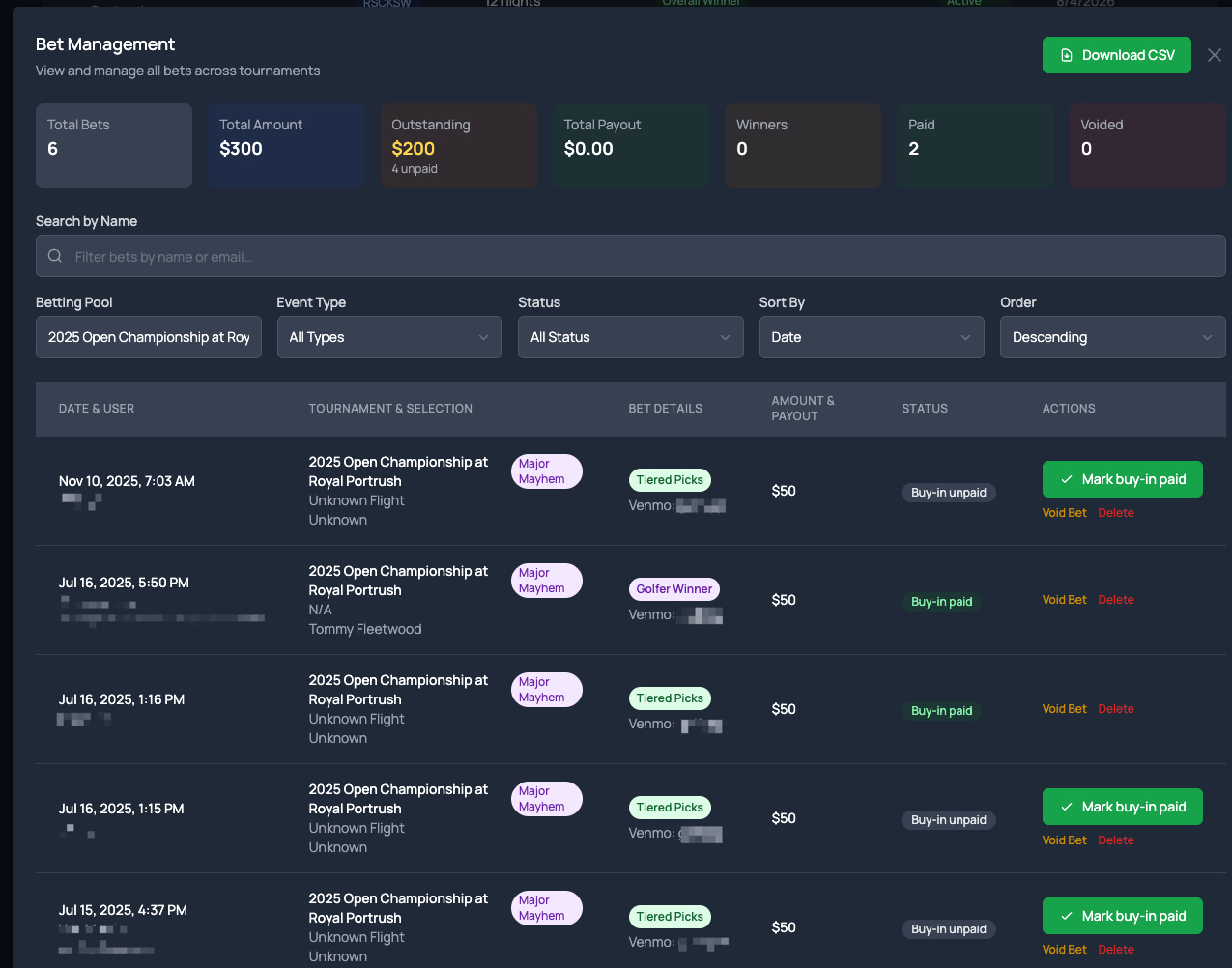
GolfApp bet management window filtered to a Major Mayhem pool for the 2025 Open Championship at Royal Portrush, showing 6 bets worth $300 with $200 outstanding across 4 unpaid entries, and a table of Tiered Picks and Golfer Winner entries with buy-in paid and unpaid statuses and mark buy-in paid actions
Bet management on a Major Mayhem pool. Straight picks and tiered entries in one table, with what's still unpaid called out at the top.

Search by name or email, filter by pool or status, and read the counters off the top: how many entries, how much is in the pot, what's still outstanding, how many winners, how many are settled. In the shot above, four entries are still unpaid and $200 of the $300 pot hasn't come in — which is the number an organizer normally has to reconstruct by hand.

Buy-in paid and payout sent are tracked separately, which is the distinction a group text can never quite hold. Mark a buy-in paid the moment cash changes hands, then settle winners one at a time or clear them all at once.

You can also set the terms up front instead of policing them: which bet types are live, a percentage held back for the house, entries in fixed $5 or $10 increments, a minimum and maximum, a cash-only mode with Venmo switched off, and payouts rounded down so nobody is chasing change when three people split the pot.

When it's done, pull a spreadsheet of every entry — who, what, how much, what status, and when it came in — plus PDF readouts for internal use and for handing out. The administrator's side in more detail.

Active

Entries are open.

Inactive

Entries are closed because play has started.

Completed

Winners are determined and payouts are ready.

Open it the week before

Pools fill best when people have time to think. Send the code out when the field is announced and members will sit with it — look at who's playing, watch a practice round, argue about it, and get in days before anyone would have gotten around to asking them.

The difference between a pool that opens a week out and one that opens Thursday morning isn't a few entries. It's the number of people who ever hear about it at all.

Bigger pot, better weekend, and an organizer who gets to enjoy the tournament like everyone else.

If you've looked at other options

There are other ways to run this. Homestretch Golf is a name we hear from groups doing exactly this, and Golf Genius covers tournament operations for a lot of clubs.

GolfApp's angle is that your members are already here. They use it for Nassau, Skins, Wolf and Scotch on Saturdays and for the fall trip, so a Masters pool is one more tab rather than a new product to be talked into. And it's free for the individual golfer, permanently — nobody hits a paywall on the way into your pool.

Common questions

What is a golf major betting pool?

It's a pool run alongside a professional tournament. Members or friends pick the pros they think will finish best, everyone's entry goes into a shared pot, and the pot pays out when the real tournament does. Clubs and groups run them for the Masters, the PGA Championship, the U.S. Open, and the Open Championship. In GolfApp the event type is called Major Mayhem.

What's the difference between a straight bet and a tiered bet?

A straight bet is one pick — you back a single golfer to win, and that's your entry. A tiered bet splits the field into tiers and you take one golfer from each, so you end up with a favorite, a mid-price name, and a long shot or two. Your worst picks are then dropped before scoring.

How many picks get dropped in a tiered pool?

You decide when you set the event up. Dropping the two lowest-scoring picks is common, but you can drop one, or drop none and count every pick. Dropping is what keeps an entry alive when one of your golfers misses the cut.

How are ties broken?

With a predicted winning score. Each participant enters what they think the winning score will be relative to par — negative for under par, positive for over, zero for even — and the closest prediction settles a tie between entries on the same total.

Can participants follow the pool during the tournament?

Yes. GolfApp pulls live scores from the tournament, so every time someone opens the app or the web panel their picks are sitting there against the real leaderboard. Nobody has to cross-reference their entry against a leaderboard by hand.

Can I enter somebody who doesn't have a GolfApp account?

Yes. An organizer can make the selections in the web panel and put that person's name in the Placing Bet For field. It's built for the participants who'd rather email you their picks than install anything, and the entry sits in the same pool as everyone else's.

How is it different from a pari-mutuel event?

The wagering idea is the same — a shared pool rather than fixed odds against a house. What changes is the field. A pari-mutuel event bets on your own club's field at a member-guest or member-member. A major pool bets on the professional field on TV that weekend.

Who can run one?

Any club, and any group. Pros and tournament administrators run them for the membership, but the same setup works for a group of friends who just want a pool going for Masters weekend.

Do participants need the mobile app?

No. They can join and place picks from the GolfApp app, from GolfApp on the web with the same join code, or in person with an organizer logging it for them. All three land in the same pool.

Can somebody enter more than once?

Yes. Multi-bet is supported throughout, so a participant can take multiple entries and settle for all of them in one go instead of one at a time.

How do people pay?

Through Venmo, or in cash with the organizer marking the entry as paid. Both work and both show up in the same record — which is the end of chasing eleven people for $20 in a group text.

How is the pool set up?

From the GolfApp web admin panel. Whoever is organizing builds the event and shares a join code, and participants only ever see the code.

What can the organizer control?

The terms are settings on the event rather than rules somebody has to enforce by hand. Hold back a percentage for the house, require entries in $5 or $10 increments, set a minimum and maximum, run the event cash-only with Venmo switched off, and round payouts down so nobody is making change when three people split the pot.

Can I get a record of every entry?

Yes. A full spreadsheet of every bet in the pool — who placed it, what they took, the amount, its status, and the timestamp — plus PDF readouts in two versions, one for internal use and one for handing out.

How does everyone know when entries close?

Every event is in one of three states: active means entries are open, inactive means they're closed because play has started, and completed means winners are determined and payouts are ready.

When should we open it?

As early as you can. Pools fill much better when people have days to look at the field and think about their picks than when they're asked to decide on the spot.

What does it cost?

GolfApp is free for individual golfers, always. For club and organizer-run events, get in touch and we'll walk you through it.
Got a pool to run this April?

Tell us what you're running and we'll walk you through setting it up, opening it early, and settling it without the spreadsheet.

Talk to us about your pool

Already set up? Head to the web admin panel.