Scotch: six points a hole, and the nerve to double them.

A 2v2 points game where every hole is worth six — and where a twist, a re-twist, and a sweep can turn one par 4 into forty-eight.

Players 4 (2v2)
Format Team points
Points per hole 5, 6, 7
In GolfApp Chicago / Scotch

What is Scotch?

Scotch is a four-player, two-on-two betting game where each hole is worth a fixed pot of points. Instead of one winner per hole, the points get carved up between the teams across a few different categories — best individual score, best combined score, birdies, and who stuck it closest.

You'll hear it called a lot of different things depending on where you play and who taught you. GolfApp lists it as Chicago / Scotch. Six-point is the most common version, and it's the one described here.

What makes Scotch different from Skins or a Nassau is that a bad hole isn't automatically a total loss. You can chunk one into the water, watch your partner save low total, and still walk off the green with points. It keeps four players engaged on every hole, right through the back nine.

Six points, four ways to win them

Every hole, these four categories are up for grabs. Win them all and you take all six.

2

Low ball

The better individual score on each team. Lowest single score takes it.

2

Low total

Both partners' scores added together. Lowest combined total takes it.

1

Birdie

Anyone on the team makes birdie.

1

Proximity

Closest to the hole in regulation — nearest ball on the green in regulation figures.

Nothing doing

No blood

Points only move when somebody wins them outright. Tie the low ball and that point sits there. Nobody makes birdie, that point goes unclaimed. Tie everything and the hole is no blood — six points on the table, zero awarded, on to the next tee.

Everything at once

The sweep

Take every available point on a hole and you've swept it — some groups call it an umbrella. A sweep doubles the hole on top of whatever it was already worth. Six points becomes twelve, just for leaving nothing behind.

The winning team tees off first

Forget traditional honors. In Scotch, the team that's ahead hits first — every hole, all day.

It's a small rule that does a lot of work. Nobody has to ask where the match stands, because you can read it off the tee box. And there's no hiding from it: when you've lost the lead, you find out in front of everyone.

More importantly, it's not etiquette — it's the betting structure. The order of play is what creates the window to double the hole.

Twists and re-twists

Here's where Scotch earns its reputation.

The team that's losing can call a twist, and every point on that hole doubles. Six points becomes twelve. It's the comeback mechanism — a way to claw back a match that's gotten away from you without needing to win six holes in a row.

If your group calls this a press, you're playing the same thing. The name changes from foursome to foursome; the mechanic doesn't.

But a twist doubles the hole for whoever wins the points. Not just for the team that called it. That's the whole gamble.

When you can call it

The timing is the entire game, and it runs in a strict order off the tee:

1

The leading team tees off

They have the honors, so they hit first — with no information about what's coming.

2

The trailing team can twist — 2x

After watching the leaders hit, but before hitting their own tee shots. Two balls in the trees is a good moment to double the hole.

3

The trailing team tees off

Now they have to back it up. The twist is already on the table.

4

The leaders can re-twist — 4x

Only if they were twisted at, and only after seeing the trailing team's tee shots. Last word, best information.

Read that order again and you'll see why the game works. Each side commits before the other, and each gets to see something first. The leaders hit blind. The trailing team decides with two tee shots' worth of information. Then the leaders get the last word, having watched all four balls.

Doubling a hole because your opponents are both behind a tree is a perfectly legal way to make friends nervous.

Say you're up on a par 4
  • Low ball — your 3 beats their 4. 2 to you
  • Birdie — that 3 was a birdie. 1 to you
  • Proximity — your partner stuck it to 10 feet. 1 to you
  • Low total — your 3 + 7 = 10, their 4 + 4 = 8. 2 to them
Straight up You 4  ·  Them 2
They twisted on the tee You 8  ·  Them 4

They doubled the hole hoping to climb back in it, and handed you eight instead. That's a twist.

Either way of writing it down works. You can enter 8 and 4, or you can net it out and enter 4 and 0. Scotch is zero-sum between two teams, so only the difference between them ever matters — GolfApp settles both exactly the same. Whichever way your group has always kept it on the back of the card is fine.

The re-twist

This is rare, and it should be. Nobody re-twists on a whim — which is exactly what makes it fun when somebody does.

How high can one hole go?

Here's where it gets dangerous. The multipliers stack, and a sweep doubles on top of everything else:

Straight up 1x 6
Sweep the hole 2x 12
Twisted 2x 12
Twisted, then swept 4x 24
Re-twisted 4x 24
Re-twisted, then swept 8x 48

So the ceiling on a 6-point hole is 48 points. One team twists, the other re-twists, and then somebody takes every point on the hole — 6 × 4 × 2.

On a par 4. In about twelve minutes. At a dollar a point, that's a very expensive tee shot into the trees.

Every group plays it differently

Six points with a 2-2-1-1 split is the most common version, but there's no governing body here. 5-point and 7-point Scotch are both common, and groups swap the categories around constantly:

  • Different point totals — 5-point, 7-point, 8-point, and 9-point versions all exist
  • Sandies, greenies, or a point for a proximity shot off the tee on par 3s
  • Extra points for an eagle, or a birdie point that doubles the rest of the hole
  • Twist rules that only unlock once a team is down a certain amount
  • Carryovers when a hole comes back no blood

All of them are correct. The version your group has played for fifteen years is the right one.

How GolfApp handles Scotch

This is exactly why we don't make you configure Scotch.

There's no setup wizard asking whether you play sandies, no toggle for twist eligibility, no form where you declare your point values. Trying to encode every group's house rules would be a losing battle — and you'd spend the whole round fighting the app instead of your buddies.

So the division of labor is simple: you do the point math, GolfApp does the bookkeeping. You decide who won what on the hole — 6-point, 5-point, 7-point, twisted, re-twisted, sandies and all — and enter the number. From there it's the app's problem.
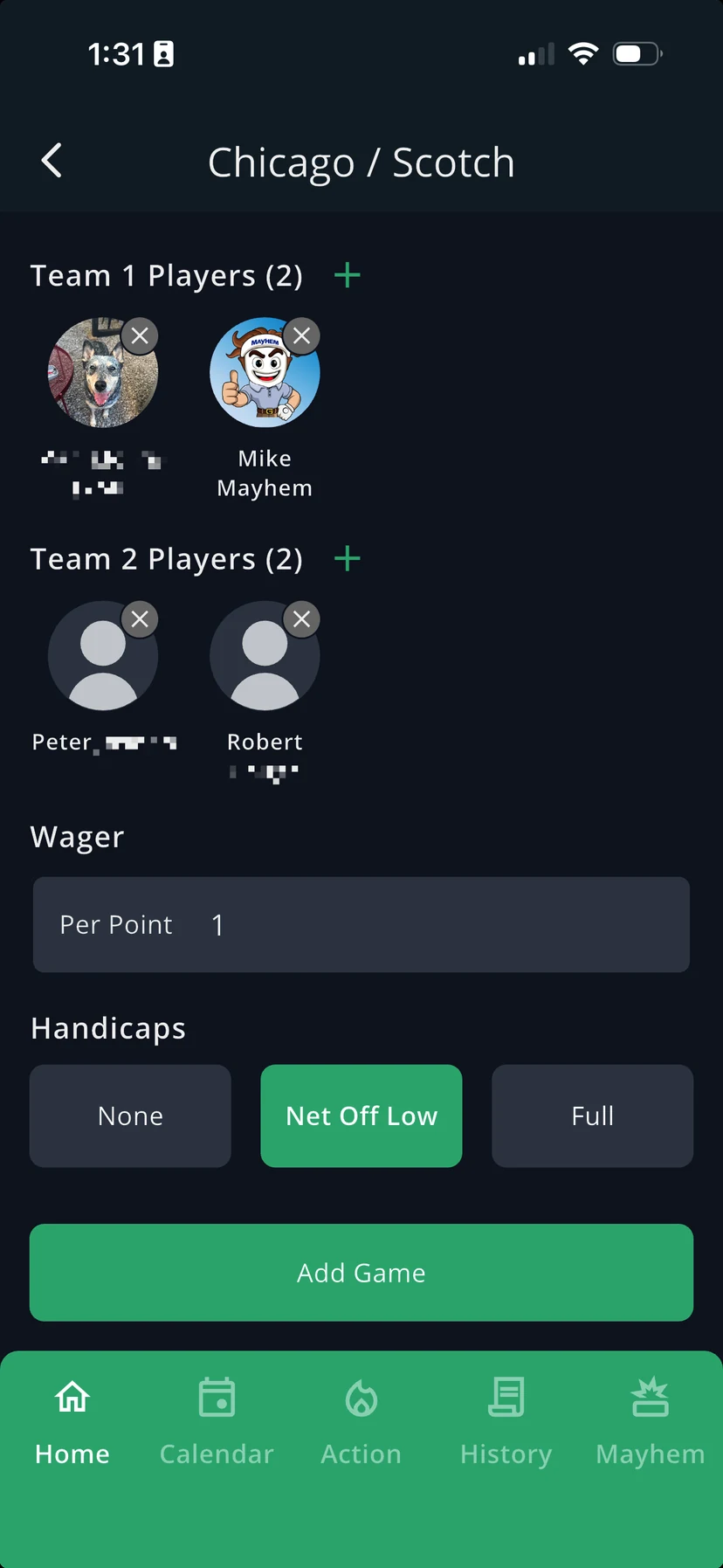
GolfApp Chicago / Scotch setup screen showing Team 1 and Team 2 player slots, a per-point wager field, and handicap options for None, Net Off Low, and Full

Setup takes about fifteen seconds

  • Pick your teams — two players a side
  • Set the wager per point — a dollar a point, a quarter, whatever the group plays for
  • Choose how handicaps apply — None for straight gross, Net Off Low to play off the lowest handicap in the group, or Full for everyone's full course handicap

That's the whole configuration. Notice what's not there: no point-value form, no twist settings, no house-rule checklist.

Two things to know before you set it up

Everyone has to be in the same foursome

Scotch can't be played across groups. Unlike Skins or a Stroke Play game that can run over an entire outing, all four Scotch players need to be in the same group — you're comparing shots on the same hole at the same time, so it doesn't translate to golfers two holes ahead of you.

You can't run Scotch and Wolf at the same time

Both games ask you to enter points by hand rather than calculating them from your scores, and two point-entry games in one round would be ambiguous — the app wouldn't know which set of points belongs to which game. Pick one. Everything else stacks on top of Scotch just fine.

Entering scores changes a little

Once a Scotch game is running, the score entry screen splits into two halves. Raw golf scores go up top, the same as always. Team points go underneath, in a section labeled with your point structure — "6pt Scotch Points" here.

Work out the hole with your group, then enter what each team won. In the shot below one team swept it 6–0.

You can enter the points gross or netted out — 8 and 4 or 4 and 0, it makes no difference. Only the gap between the two teams affects what changes hands, so GolfApp settles either version identically.
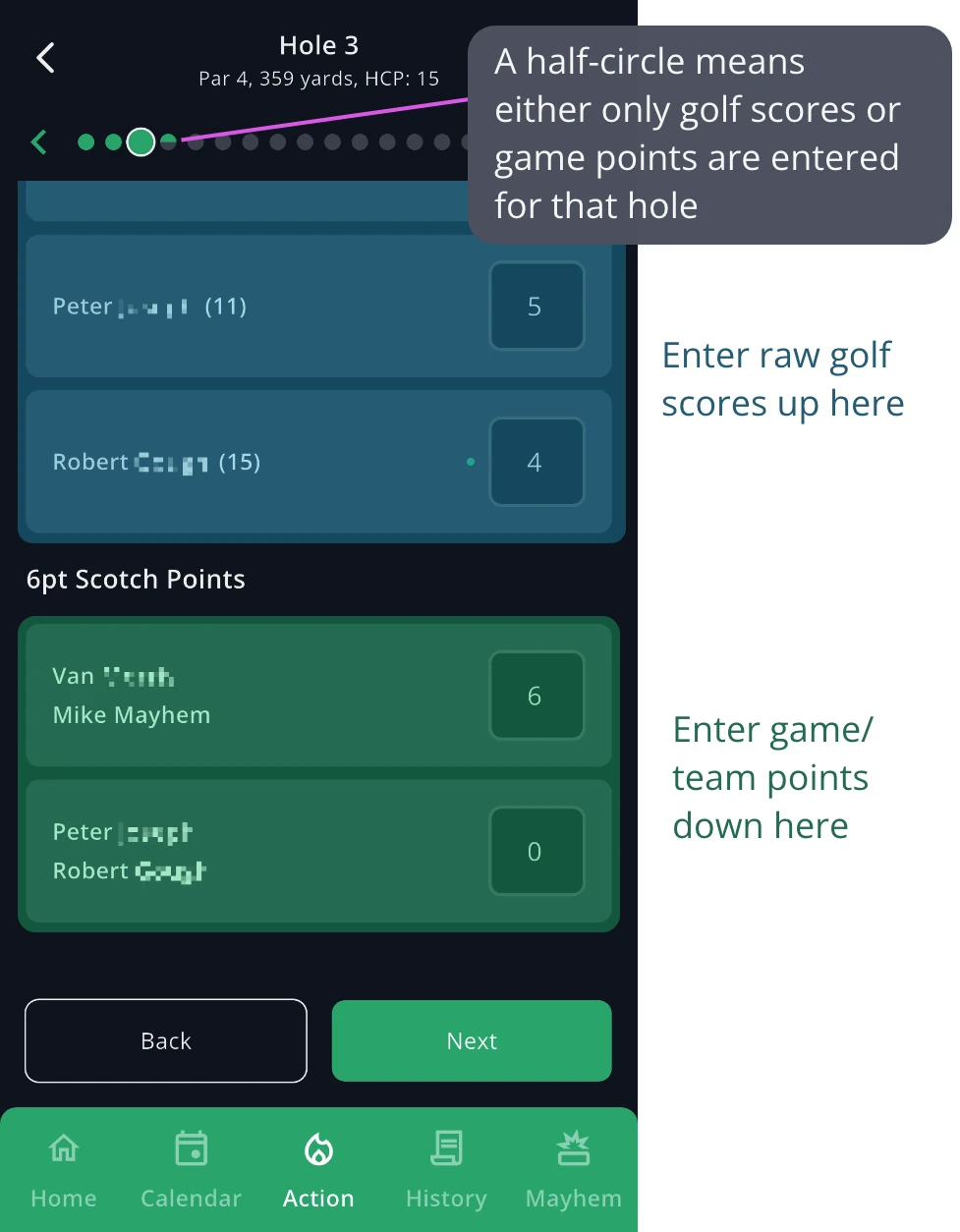
Annotated GolfApp score entry screen for hole 3 showing raw golf scores at the top and a 6pt Scotch Points section below for entering each team's points
Raw scores up top, team points below. The hole indicator shows a half-circle when only one of the two has been entered.

Keep an eye on the hole dots along the top. A filled circle means that hole is complete. A half-circle means only one side of it is in — either the golf scores or the game points, but not both. It's a quick way to catch the hole where everybody forgot to settle up the points before driving off.

What it tracks for you

From there GolfApp keeps the running ledger — what you scored on every hole, the cumulative point total for the game, and the dollar figure once your per-point wager is applied.
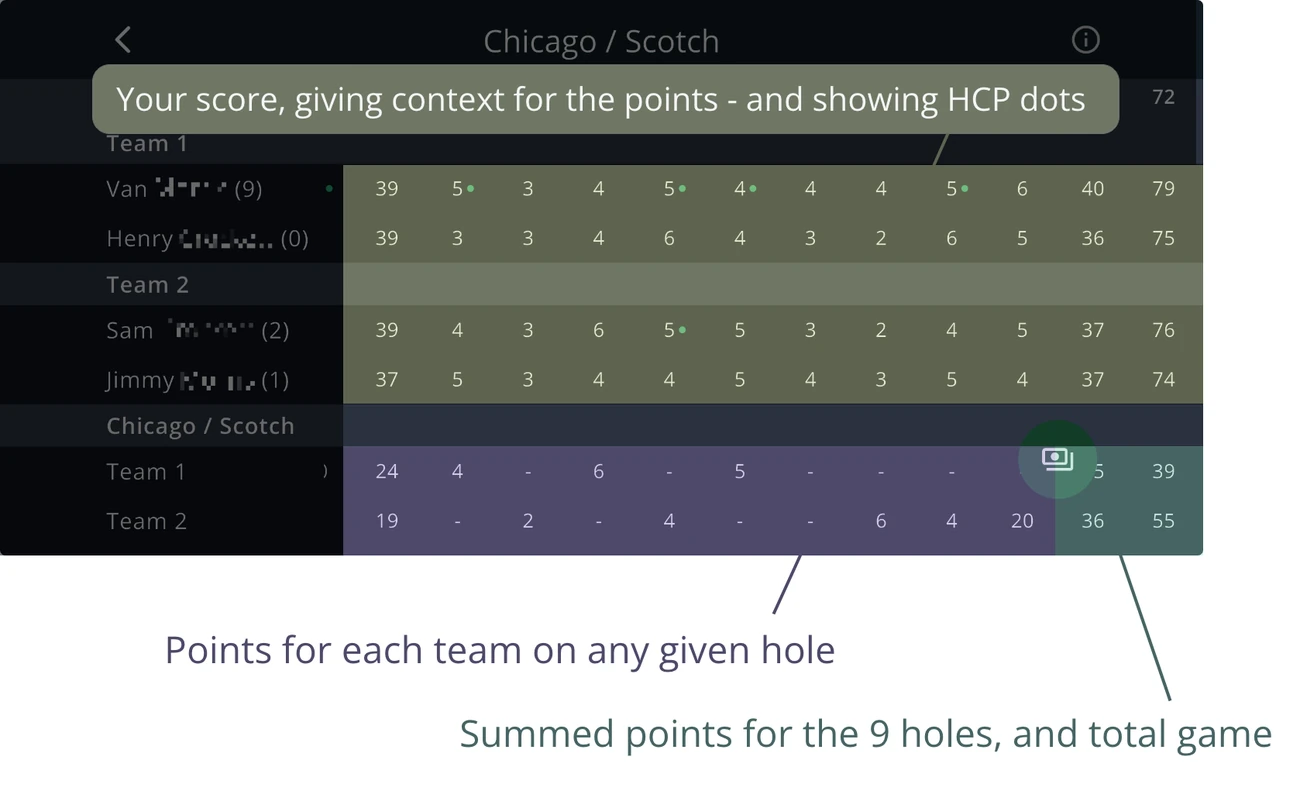
Annotated GolfApp Chicago / Scotch scorecard showing player scores with handicap dots, per-hole points for Team 1 and Team 2, and summed points for the nine and the full game
The Scotch scorecard: raw scores up top for context, team points below, totals on the right.

The scorecard shows three things at once:

  • Everyone's actual scores, so the points have context — you can see exactly why a hole went the way it did
  • Handicap dots for this specific game. This matters more than people expect: if you're running Scotch alongside a Nassau, a player can be stroking on different holes in each game depending on how handicaps are set. The dots you see here are the ones that count for Scotch
  • Points per hole, summed by nine and for the full game — plus how far ahead or behind you are at any point

And if you'd rather not open the detailed scorecard in the middle of a round, don't. Put it on your Lock Screen with a Live Activity and the running total sits there between shots — no unlocking, no tapping.

Play the 7-point version. Play with sandies. Re-twist on the 18th. The math still works, because the app never had an opinion about your rules in the first place.

At the end, everyone settles up — with a Venmo request one tap away.

Common questions

How many players do you need for Scotch?

Four — two teams of two. Scotch is a team game, so a foursome splitting into partners is the standard setup.

What are the six points in Scotch?

In the most common setup: 2 points for low ball, 2 points for low total, 1 point for a birdie, and 1 point for closest to the hole in regulation. Point totals vary by group — 5-point and 7-point Scotch are both common, and GolfApp works with any of them.

What does 'no blood' mean in Scotch?

It means a point went unclaimed. If both teams tie a category — same low ball, same low total, nobody made birdie — nobody scores that point. A hole where everything ties is a no blood hole and no points change hands.

What is a twist in Scotch?

A twist doubles all the points on a hole. Some groups call it a press — it's the same thing. The trailing team calls it after the leading team tees off but before hitting their own tee shots, and it applies to whoever ends up winning the points, not just the team that called it. If they twist, the leaders can answer with a re-twist after the trailing team tees off, taking the hole to 4x.

What is a sweep or umbrella in Scotch?

A sweep — also called an umbrella — is when one team captures every available point on a hole. Winning them all doubles the hole on top of whatever it was already worth. On a straight-up 6-point hole a sweep is worth 12.

What is the most points you can win on one hole in Scotch?

In a 6-point game, 48. Get re-twisted to 4x and then sweep every point on the hole, which doubles it again: 6 x 4 x 2 = 48 points on a single hole.

Who tees off first in Scotch?

The team that's winning has the honors and tees off first, every hole. That order is what creates the twist window: the trailing team hits second, so they get to watch the leaders' tee shots before deciding whether to double the hole.

Can you play 5-point or 7-point Scotch?

Yes. Six points is the most common, but 5-point, 7-point, and other totals are all played. GolfApp doesn't lock you into a point structure — you work out the points on the hole and enter them, so any variation works.

Do you enter gross points or the net difference in Scotch?

Either. If a hole finishes 8 to 4, you can enter 8 and 4, or net it out and enter 4 and 0. Scotch is zero-sum between two teams, so only the difference matters — GolfApp produces the same result either way.

Can you play Scotch across multiple groups?

No. All four Scotch players have to be in the same foursome. The game compares shots on the same hole at the same time, so unlike Skins or Stroke Play, it can't be run across groups in a larger outing.

Can you play Scotch and Wolf in the same round?

No. Scotch and Wolf both require you to enter points by hand rather than calculating them from raw scores, so GolfApp can't tell which points belong to which game. Pick one — any other game can be stacked on top of Scotch.

Can an app keep score for Scotch?

Yes. GolfApp scores Scotch without making you configure your house rules. You enter the points each team won on a hole, and GolfApp applies your dollar amount per point and settles up at the end.

Play Scotch. Skip the bookkeeping.

Free for life. No subscription, no premium tier.

Download for Free