
Skins: every hole is its own prize.
One prize per hole, and you have to win it outright. It's the game that works with four golfers or forty, which is why it's the one everybody defaults to.
One prize per hole, and you have to win it outright. It's the game that works with four golfers or forty, which is why it's the one everybody defaults to.
Skins breaks a round into eighteen separate contests. Each hole carries one prize — the skin — and the lowest score on that hole takes it.
The catch, and the entire reason the game is any good: you have to win the hole outright. Make the only birdie on the 4th and it's yours. Make a birdie and so does somebody else, and neither of you gets anything. A tie doesn't split the skin. It kills it.
That one rule is what makes skins loud. In a stroke play round a tie is a non-event. Here it's the difference between collecting and walking to the next tee with nothing, and it means the guy who just made a routine par can knock out two birdies by matching them.
Skins is also the least demanding game on the sheet. No partners, no teams, no format to explain on the first tee. Everyone plays their own ball, and anybody who shows up late can still be in it.
This is the part people get wrong when they run it on paper. A skin doesn't have a fixed price at the start of the round.
So a round where the group keeps tying is a round where the few skins that do get won are worth a fortune. A round where almost every hole is claimed spreads the same pot thin across a dozen winners.
You don't have to think about any of it while you're playing. Set the buy-in when you create the game and GolfApp works the rest out at the end.
Two ways to play it, and the choice matters more in skins than in most games.
Gross skins uses raw scores with no handicaps at all. Clean and simple, and if there's a scratch player in the group he's going to take most of the money.
Net skins applies everyone's full course handicap. Now the 18-handicap who gets a stroke on the 6th can make a net 3 and beat everybody there, and suddenly the whole field has a live interest on every hole. For a mixed group — which is most groups — this is the one to play.
You pick when you create the game, and the scorecard marks which holes each player is stroking on so nobody has to work it out in their head.
Pick one when you set the game up. They change how a tied hole behaves and how hard a skin is to keep.
Every hole is worth one skin. Win it outright and it's yours. Tie it and that skin is simply gone — nobody gets it, and the next hole starts fresh.
A tied hole doesn't vanish — it rolls forward. Tie the 1st and there are two skins on the 2nd. Tie that too and the 3rd is worth three.
Winning the hole isn't enough. You have to back it up with a net par on the next hole to keep the skin you just won.
Carryover turns a quiet front nine into a very loud back nine. Nothing gets won on the 1st, so the 2nd is worth two. Tie that and the 3rd is worth three, and by the time somebody finally makes a putt they're picking up a pile.
It works best in a small game — a skins game inside your own foursome. With four players, ties are common enough that pots build but rare enough that they eventually get paid. Turn carryovers on in a twenty-man outing and somebody wins nearly every hole anyway, so there's nothing to carry.
Validation is for groups who think a skin should be earned rather than stumbled into. Win a hole and you've got it provisionally — but you need a net par on the next hole to validate it and keep it.
It punishes exactly the thing skins otherwise rewards: the one miraculous hole in an otherwise scattered round. Chip in for birdie on the 7th, then make a triple on the 8th, and that birdie was worth nothing.
Skins is simple to explain and genuinely annoying to track. Somebody has to notice every tie, remember which holes carried, apply strokes correctly for a net game, and then work out what a skin ended up being worth once the round is over.
You enter the scores. That's the whole job.
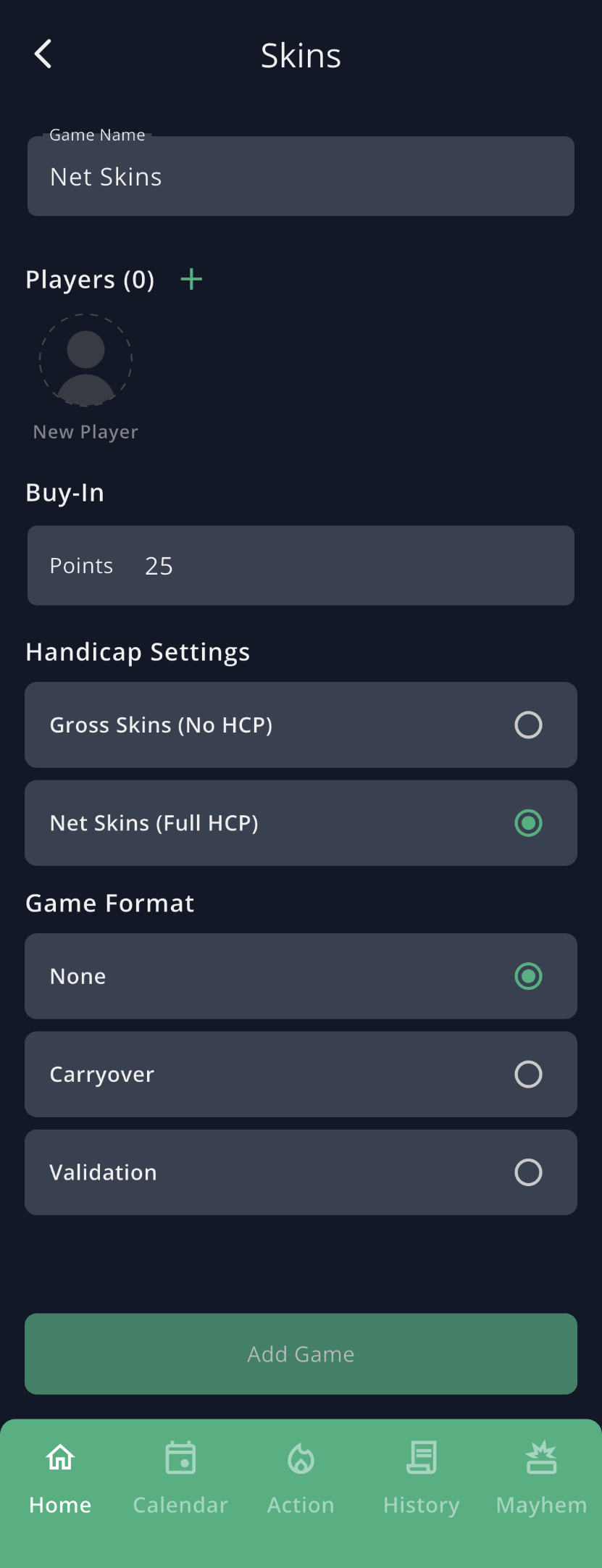
Tap Add Game and it's running. Nothing else to configure, and nothing to keep track of by hand for the next four hours.
The scorecard shows the whole field hole by hole, with each player's handicap beside their name and a dot on the holes where they're getting a stroke. When a hole is won outright, that score gets highlighted — so you can see at a glance who took what and which holes went nowhere.
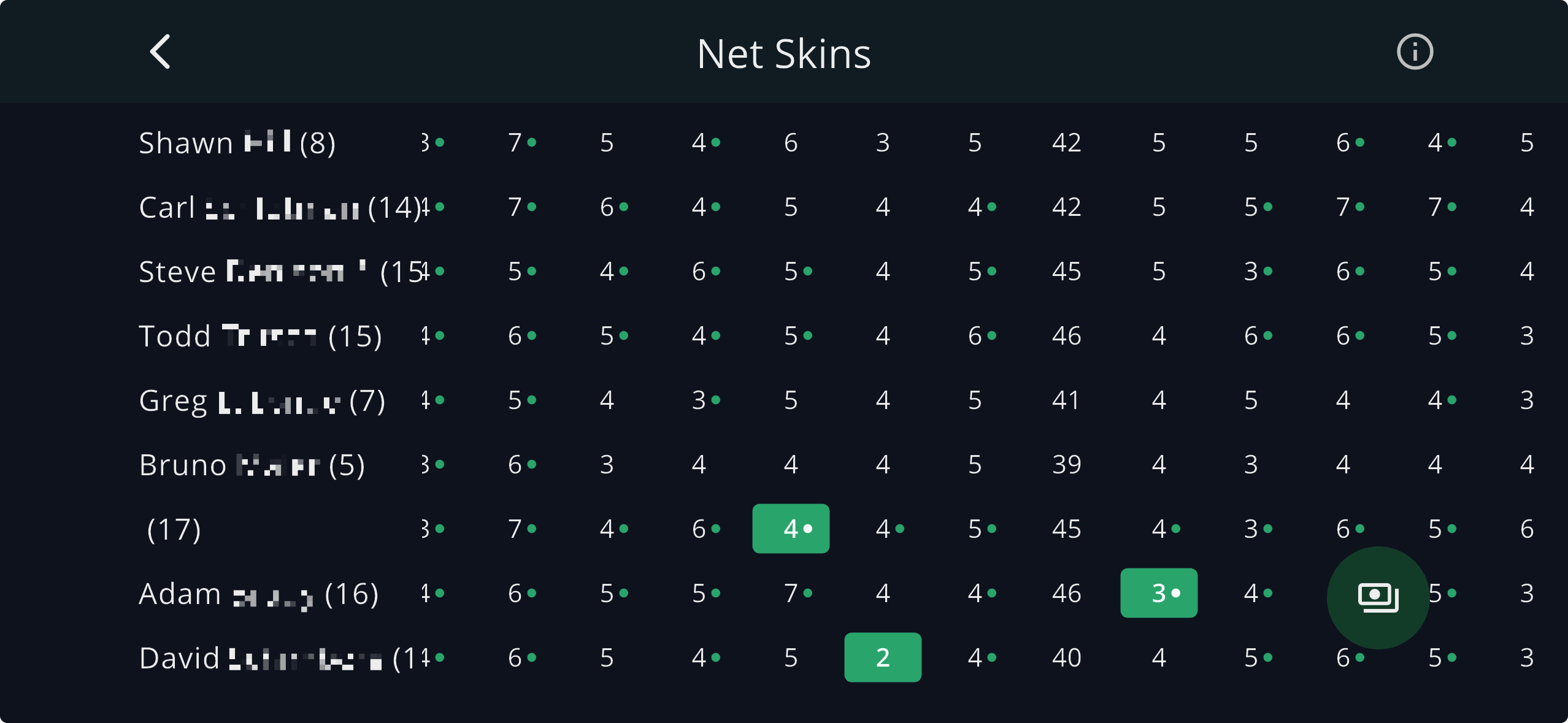
In a big outing that view is the argument-ender. Nobody has to trust that somebody wrote it down right on the 11th tee, because the hole is sitting there with the winning score marked on it.
At the end you get the summary: who won, how many skins each of them took, and what a single skin turned out to be worth once the pot was divided.
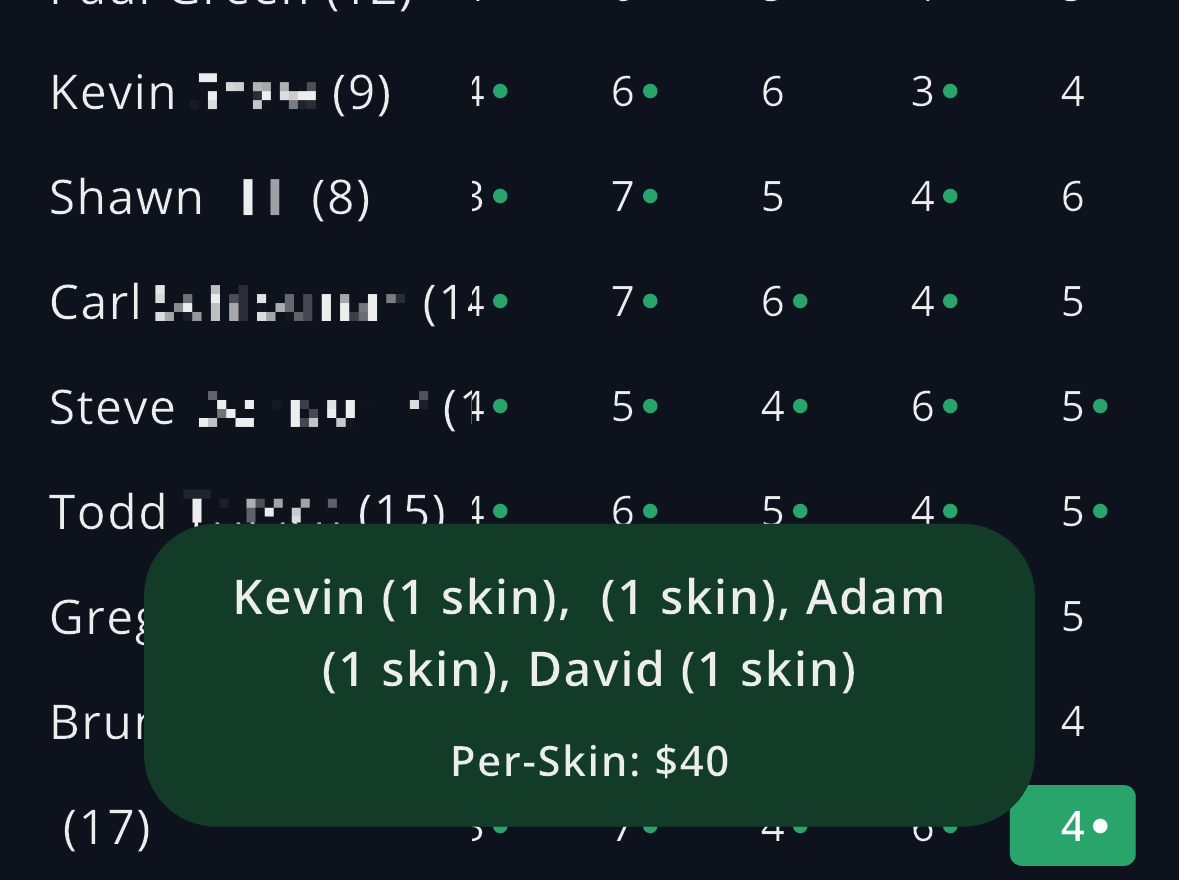
Settle up from there, with a Venmo request a tap away. No spreadsheet, and no working out long division on the 18th green.
This is where skins pulls away from every other game on the list. It doesn't need anyone to be standing next to anyone.
A hole is scored as soon as the players have entered a score for it, so a twenty-man outing across five groups can run a single skins game over the entire field. You're in the first group off, somebody two hours behind you makes an eagle on the 14th, and your skin quietly disappears while you're already in the clubhouse.
That's not a bug. That's the tournament. See running games across multiple groups for how it's set up.
And because skins scores off raw scores, it stacks on top of everything else. Run it across the whole outing while a Nassau runs against your buddy in the group behind you and a Scotch game runs inside your own foursome. Same scores, three games, one settle-up.
Every hole is its own contest. The lowest score on a hole wins that hole's skin — but you have to win it outright. If two or more players tie for low, nobody takes the skin. At the end of the round, everyone who won skins gets paid out of the pot.
It depends on the format you chose. In a straight skins game the skin is simply lost and the next hole starts over at one skin. With carryover turned on, the tied skin rolls forward and gets added to the next hole, so a hole late in a round can be worth several skins at once.
A carryover means a tied hole's skin isn't lost — it carries to the next hole. Tie the 1st and the 2nd hole is worth two skins. Tie that as well and the 3rd is worth three. It works best in a smaller game inside one foursome, where ties are less frequent and a carried pot actually builds.
Validation means you have to prove the skin was real. After you win a hole, you need a net par on the following hole to validate it and keep it. Make a mess of the next hole and the skin you just won goes away.
Gross skins uses raw scores with no handicaps, so the best golfer in the group has a real edge. Net skins applies each player's full course handicap, which is what makes a skins game work with mixed abilities. GolfApp asks you to pick one when you set the game up.
It isn't fixed when you start. Everyone pays the same buy-in, so the pot is the buy-in times the number of players, and at the end that pot is divided by the number of skins that were actually won. A round where only a few skins get won makes each one worth a lot; a round where nearly every hole is won spreads the pot thin.
Anything from a couple of golfers up to 20 or more. Skins scales better than almost any other betting game because nobody needs a partner and nobody needs to be in your group — which is what makes it the standard game for a big outing.
Yes. Skins doesn't require everyone to be in the same foursome. A hole is scored as soon as the players have entered their scores for it, so an outing with four or five groups can run one skins game across the whole field.
Yes. Skins stacks on top of almost anything — run it across the whole outing while a Nassau or a Scotch game runs inside your own foursome. Everything scores off the same set of raw scores you're already entering.
GolfApp scores skins — net or gross, with carryovers or validation, across as many groups as you like — free for life, with no subscription or premium tier.
 Nassau
 Three bets in one round: front nine, back nine, and the overall. Automatic presses included.
 Scotch
 Six points a hole between two teams, with twists and re-twists that can turn a par 4 into forty-eight.
How one game runs over an outing with four foursomes in it.
A foursome is the perfect betting group. Here's what to play.
Free for life. No subscription, no premium tier.
Download for Free